
Introduction
A waterproof mattress encasement is designed to surround and protect the mattress rather than simply cover its top surface. It can help protect against liquid penetration, dust mites, and everyday contamination when the material and complete construction are properly designed.
For bedding brands, wholesalers, hospitality suppliers, and healthcare product distributors, a reliable mattress encasement requires more than a waterproof fabric. The enclosure structure, zipper construction, closure security, mattress fit, and material performance all play important roles.
One design detail that deserves particular attention is the zipper slider. If the zipper is accidentally moved or left exposed, the effectiveness of the complete enclosure may be compromised.
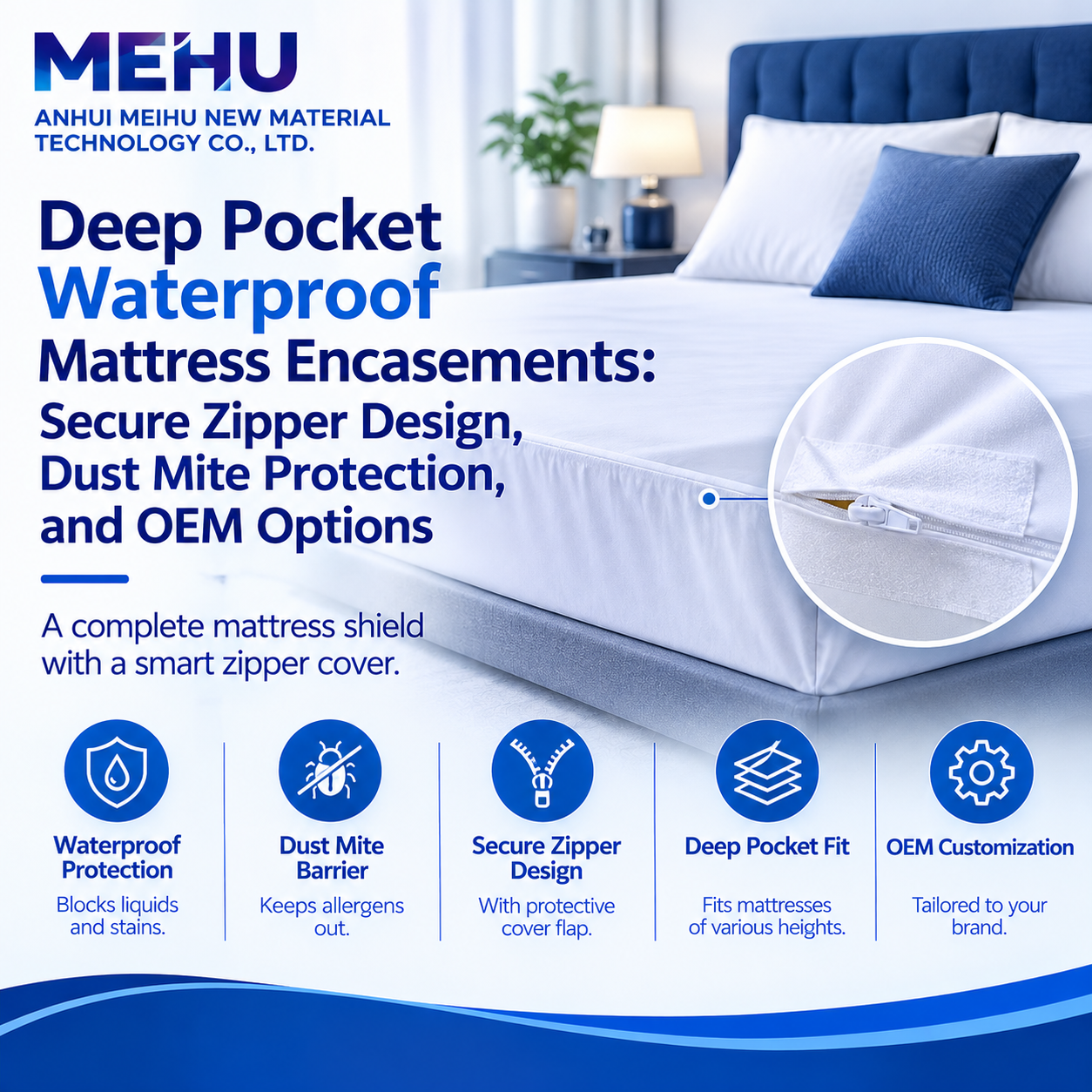
At Anhui Meihu New Material Technology Co., Ltd., our deep pocket waterproof mattress encasement features a hidden zipper design with an additional protective flap covering the zipper slider. This construction helps keep the closure secured and provides an additional barrier at an important opening point.
This guide explains the key design and sourcing considerations for B2B buyers.
1. What Is a Waterproof Mattress Encasement?
A mattress encasement is designed to surround the mattress on all sides, including the top, bottom, and side panels.
Unlike a conventional fitted mattress protector that mainly covers the top and may use elastic around the edges, a full encasement uses a closure system to enclose the mattress.
This construction can offer several advantages:
Helps protect the mattress from liquid penetration.
Creates a barrier against dust mites and other unwanted particles.
Covers the entire mattress rather than only the sleeping surface.
Helps protect the mattress from daily wear and contamination.
Can be designed for different mattress sizes and thicknesses.
For B2B buyers, it is important to distinguish a full mattress encasement from a standard fitted mattress protector because the product construction and closure requirements are different.
2. Why Secure Zipper Design Matters
The zipper is one of the most important components of a full mattress encasement.
It allows the mattress to be inserted and removed, but it also creates an opening in the protective enclosure.
A suitable zipper design should consider:
Smooth opening and closing.
Secure closure along the zipper track.
Suitable zipper length and positioning.
Protection of the zipper slider.
Overall construction compatibility with the fabric.
A hidden zipper can give the product a cleaner appearance and conceal the zipper when closed.
However, hiding the zipper alone does not necessarily prevent the slider from moving accidentally. The zipper pull itself needs attention.
3. Meihu’s Protective Zipper Slider Cover Flap
One of the key design details of Meihu’s mattress encasement is the additional fabric flap used to cover the zipper slider after closing.
A conventional zipper closure may leave the slider accessible even when the zipper is fully closed. During handling, installation, or normal use, the slider may be moved unintentionally.
Meihu’s design adds a protective fabric flap over the zipper slider.
This structure offers several practical benefits:
Covers the zipper slider
The flap covers the slider after the zipper has been closed, helping keep this component concealed.
Reduces the risk of accidental opening
By covering the zipper pull, the design helps reduce the chance of the slider being accidentally moved and the closure becoming loose.
Supports the enclosure barrier
For products intended to provide a barrier against dust mites, maintaining a securely closed enclosure is important. The protective flap adds an extra design feature around the zipper closure.
Provides a cleaner finished appearance
The covered slider also gives the finished product a more organized and concealed zipper appearance.
This is a useful detail for mattress encasements where closure security matters as much as the waterproof fabric itself.
The protective flap should be evaluated as part of the complete zipper construction. Dust mite barrier performance also depends on the fabric, zipper track, seams, fit, and overall enclosure design. Appropriate finished-product testing is needed to substantiate specific performance claims.
4. Choosing the Right Waterproof Material
The fabric used in a mattress encasement affects comfort, flexibility, waterproof performance, and durability.
Meihu offers several material options for waterproof mattress protection products, including:
Knitted fabric
Flexible and suitable for products that require a soft surface and adaptable fit.
Microfiber fabric
Provides a smooth surface and a soft hand feel, making it suitable for bedding applications where comfort is important.
Cotton terry fabric
Offers a textured surface and absorbent feel for buyers who prefer a traditional terry fabric construction.
Coral fleece
Can provide a soft, brushed surface for products requiring a warmer textile feel.
Air layer fabric
Offers a different textile structure and can be considered for specific comfort and product design requirements.
Quilted fabric
Combines a quilted textile construction with a layered appearance and optional padding.
For waterproof mattress encasements, these textile options can be combined with a TPU waterproof membrane according to the required construction.
Buyers should evaluate the complete laminated fabric rather than focusing only on the face material.
Important specifications include:
Face fabric composition and GSM.
TPU membrane thickness.
Waterproof performance and test method.
Fabric flexibility and hand feel.
Bonding quality.
Washing durability.
The appropriate construction depends on the target market, mattress design, and performance requirements.
5. How to Select the Correct Deep Pocket Size
A mattress encasement needs to fit the mattress correctly.
The length and width determine the surface dimensions, while mattress thickness determines the required depth of the side panels.
Common mattress size references include:
Mattress Size Approximate Dimensions
Twin 39″ × 75″
Twin XL 39″ × 80″
Full / Double 54″ × 75″
Queen 60″ × 80″
King 76″ × 80″
California King 72″ × 84″
These are common size references. Actual dimensions and tolerances should be confirmed for each target market.
Pocket depth is equally important.
Before requesting a quotation, buyers should provide:
Mattress length.
Mattress width.
Mattress thickness or height.
Any additional allowance required for the fit.
The preferred finished dimensions and tolerance.
For deeper mattresses, the side-panel dimensions need to be developed accordingly.
Do not assume that two mattresses with the same length and width have the same required encasement size. Different mattress heights may require different constructions.
6. Waterproof and Dust Mite Protection Work Together
Waterproof performance and dust mite protection are related product features, but they are not exactly the same.
A TPU membrane provides a liquid barrier when incorporated into a suitable fabric construction.
A dust mite barrier requires attention to the complete enclosure, including the fabric structure, zipper closure, seams, and overall fit.
For this reason, buyers should evaluate:
1.The barrier performance of the selected fabric.
2.The zipper construction and closure security.
3.The protective flap covering the zipper slider.
4.The quality of sewn seams and other openings.
5.The finished product’s performance under appropriate testing.
A waterproof fabric alone does not prove that an entire encasement prevents dust mites from passing through every opening.
For products making specific dust mite or allergen barrier claims, finished-product testing should support the intended marketing language.
7. OEM and Private Label Customization Options
Different bedding brands may require different product specifications depending on the target market and price positioning.
Meihu supports customized mattress encasement development, including:
Product Feature Customization Options
Face fabric Cotton terry, knitted fabric, microfiber, coral fleece, air layer, and quilted fabric
Waterproof layer TPU membrane construction
Mattress size Twin, Twin XL, Full, Queen, King, California King, and customized dimensions
Mattress depth Customized according to mattress measurements
Zipper Hidden zipper design
Zipper protection Protective flap covering the zipper slider
Color Standard or customized colors
Packaging Customized packaging with brand logo
Labeling Brand and care labels
For private label projects, buyers should provide their preferred fabric, dimensions, zipper requirements, labeling artwork, and packaging specifications during the development stage.
The final material construction and product details should be confirmed through sample approval.
8. Sample Evaluation Before Bulk Production
Before placing a bulk order, buyers should evaluate the complete mattress encasement rather than approving only the raw fabric.
A practical sample evaluation process should include:
Fabric inspection
Check the surface, material construction, waterproof membrane, flexibility, and overall appearance.
Zipper operation
Open and close the zipper several times. Check for smooth operation and confirm that the slider can be properly covered by the protective flap.
Mattress fitting
Install the sample on a mattress with the specified dimensions and thickness. Check the fit, side-panel coverage, and ease of installation.
Closure inspection
Check that the zipper is fully closed and that the protective flap covers the slider as intended.
Waterproof testing
Evaluate the finished product using the agreed test method, paying attention to seams and other construction areas.
Washing evaluation
Where repeated washing is expected, test the sample under the proposed care instructions and inspect the fabric, zipper, and construction afterward.
A written product specification and approved reference sample help establish consistent expectations for mass production.
9. Why Source Mattress Encasements from Meihu?
Anhui Meihu New Material Technology Co., Ltd. manufactures waterproof bedding products and TPU laminated waterproof fabrics for B2B customers.
Our deep pocket waterproof mattress encasement combines several important product features:
Full mattress enclosure design.
TPU waterproof membrane.
Multiple face fabric options.
Hidden zipper construction.
Additional protective flap covering the zipper slider.
Customized mattress sizes and colors.
Private label packaging options.
Our current product listing specifies a MOQ of 500 pieces, subject to final confirmation according to the selected product specifications and order requirements.
For brands and wholesalers developing waterproof mattress encasements, we can discuss material selection, product construction, customized dimensions, sampling, and packaging requirements.
Conclusion
A well-designed waterproof mattress encasement requires more than a waterproof textile. The full enclosure, zipper construction, protective flap, material selection, and mattress fit all contribute to the finished product.
Meihu’s protective zipper slider cover flap is an additional design detail that helps reduce the risk of accidental zipper movement and supports a securely closed enclosure.
For B2B buyers looking for customized waterproof mattress encasements, evaluating these construction details before bulk production can help ensure that the final product meets the intended requirements.
Contact Anhui Meihu New Material Technology Co., Ltd. to discuss deep pocket waterproof mattress encasements, OEM customization, and sampling.
Email: trade@anhuimeihu.com
Website: www.meihumaterial.com
Product Page: Deep Pocket Waterproof Mattress Encasement
Post time: Nov-17-2026