
From an Idea to a Production-Ready Waterproof Fabric
For many B2B buyers, a new waterproof product starts with a simple requirement:
“We need a soft, waterproof fabric for a mattress protector.”
But turning that requirement into a production-ready fabric takes several steps.
The final fabric may need to meet specific requirements for:
GSM
Width
Hand feel
Waterproof performance
Breathability
Stretch
Washing durability
Cost
At Meihu, customized waterproof fabric development usually follows a process from requirement → sample → testing → approval → mass production.
1. Understanding the Customer’s Product
The first step is understanding the finished product.
We need to know:
What is the fabric used for?
What market is it intended for?
What size is the finished product?
What hand feel is required?
How often will it be washed?
What is the target price?
For example, a waterproof mattress protector for home bedding may require a different construction from a nursing care product.
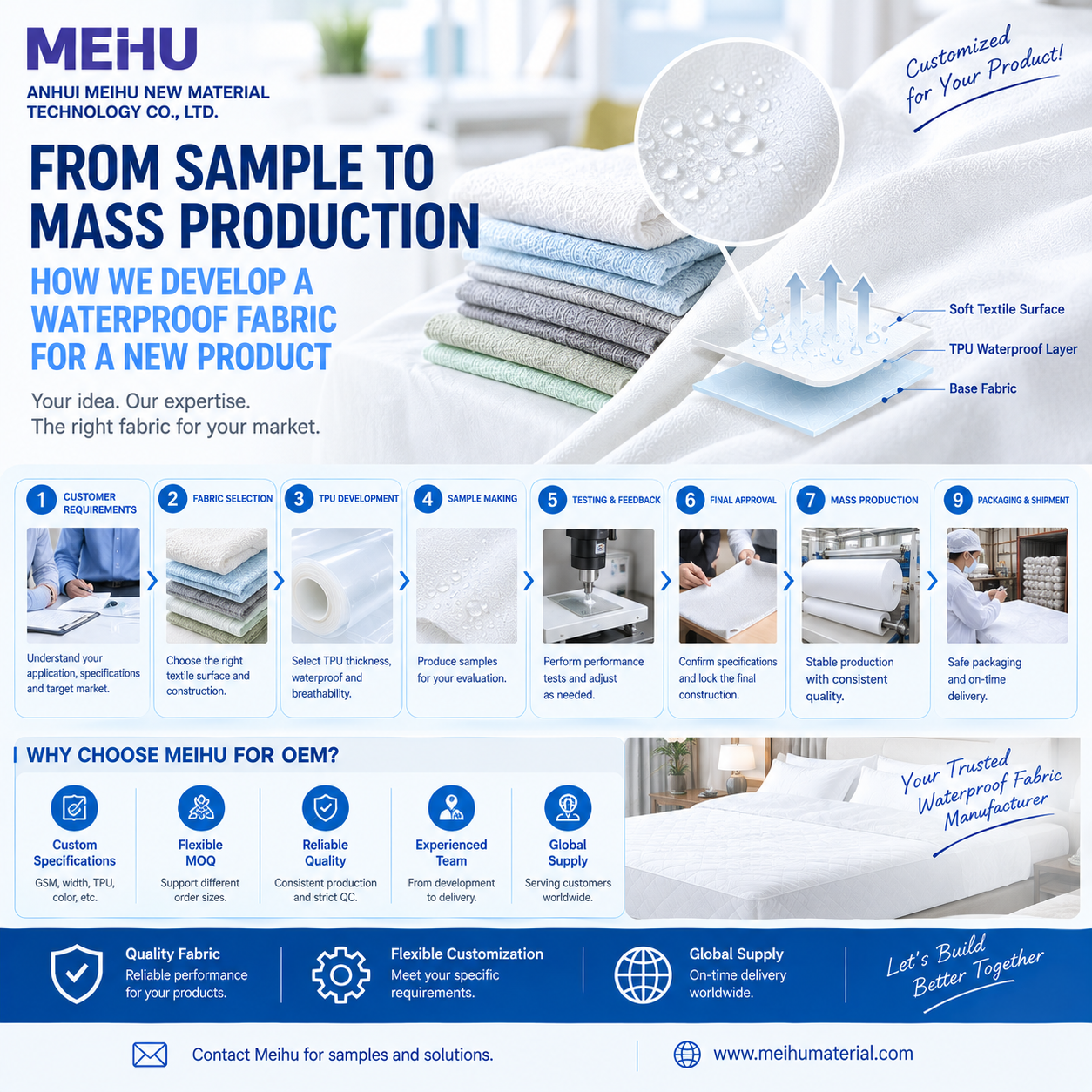
2. Selecting the Face Fabric
Once the application is clear, we can discuss the textile surface.
Possible options include:
Knitted fabric
Cotton terry
Microfiber
Coral fleece
Quilted fabric
Other customized textile constructions
The face fabric affects the appearance, hand feel, weight, and overall positioning of the finished product.
3. Developing the TPU Construction
The waterproof layer is then matched to the application.
Important specifications can include:
TPU thickness
Waterproof performance
Breathability
Flexibility
Lamination requirements
The objective is to create a balanced construction rather than maximize one specification.
For example:
Too heavy may increase cost and shipping weight.
Too stiff may affect comfort.
Too light may not meet the customer’s performance requirements.
4. Making the First Sample
After the basic specifications are confirmed, a sample can be developed.
The customer can then evaluate the actual fabric rather than relying only on a specification sheet.
Typical sample evaluation may include:
Appearance
Hand feel
Width
GSM
Waterproof performance
Breathability
Stretch
Finished product performance
This stage is particularly important for OEM development.
5. Customer Testing and Feedback
The first sample is rarely the end of the process.
The customer may come back with comments such as:
“The fabric is too thick.”
“We need more stretch.”
“The surface should be softer.”
“The waterproof performance needs to be higher.”
This feedback can be used to adjust the construction.
A second or third sample may therefore be necessary before final approval.
6. Confirming the Final Specification
Once the sample meets the customer’s requirements, the key specifications should be confirmed.
For example:
Fabric: 100% Polyester Knitted Fabric
GSM: XX gsm
Width: XXX cm
TPU: 0.015 mm
Color: Custom
Waterproof Performance: According to agreed test requirement
The approved sample and specifications then become the reference for mass production.
7. Moving to Mass Production
After approval, production can be scheduled.
The manufacturing process may include:
Raw Material Preparation
↓
Fabric Production
↓
TPU Lamination
↓
Inspection
↓
Roll Packaging
↓
Final QC
↓
Container Loading
↓
Shipment
This connects product development with the actual supply chain.
8. Maintaining Consistency During Production
Producing one good sample is not enough.
The challenge is reproducing the same characteristics during large-scale production.
The production team and QC team monitor factors such as:
GSM
Width
Color
Lamination
Surface appearance
Roll condition
The approved sample provides an important reference for production.
9. From Fabric to Finished Product
In many projects, Meihu supplies the waterproof fabric directly to manufacturers.
In other projects, customers need finished products such as:
Mattress protectors
Mattress encasements
Pillow protectors
Waterproof bed sheets
Nursing care products
This allows the customer to choose between fabric supply and finished-product OEM according to their business model.
How Long Does Development Take?
The exact timeline depends on the product.
It can be affected by:
Availability of raw materials
Custom colors
New fabric constructions
Testing requirements
Sample revisions
Customer approval
For standard materials, development can generally move faster.
For completely new constructions, more time may be required.
The best approach is to confirm the development requirements at the beginning of the project.
What Makes a Good OEM Development Process?
A successful project usually depends on three things:
Clear Requirements
The supplier needs to understand what the finished product must achieve.
Fast Feedback
Customer comments should be communicated clearly after sample testing.
Consistent Production
Once the sample is approved, mass production needs to follow the agreed specification.
This turns a sample into a repeatable commercial product.
Final Thoughts
Developing waterproof fabric isn’t simply about choosing a waterproof membrane.
It is about finding the right combination of:
Textile Surface + TPU + Specifications + Product Design + Target Cost
At Meihu, we support B2B customers from initial fabric selection and sampling through OEM development, mass production, quality control, packaging, and export shipment.
If you are developing a new mattress protector, healthcare product, hotel bedding product, or other waterproof textile product, send us your requirements.
Let’s develop the right fabric construction for your product.
Post time: Sep-18-2026