
The pet products market has grown significantly in recent years, and with it, buyer expectations for waterproof pet mats, blankets, and bed liners have risen considerably. Pet product brands and private label buyers sourcing waterproof fabric for these applications face a specific set of performance requirements that differ meaningfully from bedding or medical textile sourcing.
This guide outlines what pet product manufacturers and brand buyers should consider when selecting and sourcing waterproof fabric for pet mat and pet blanket applications.
Why Waterproof Performance Matters in Pet Products
Pet mats and blankets are routinely exposed to urine, water from drinking bowls, mud, and general moisture — often repeatedly throughout the day. A fabric that fails to maintain its waterproof barrier allows liquid to penetrate through to the surface beneath, which creates hygiene problems, odor retention, and a shortened product lifespan.
For pet product brands, fabric failure is also a customer satisfaction and returns risk. A waterproof pet mat that leaks after a few washes is a product review problem as much as a quality problem. Choosing the right fabric construction from the outset is the most cost-effective way to avoid this.
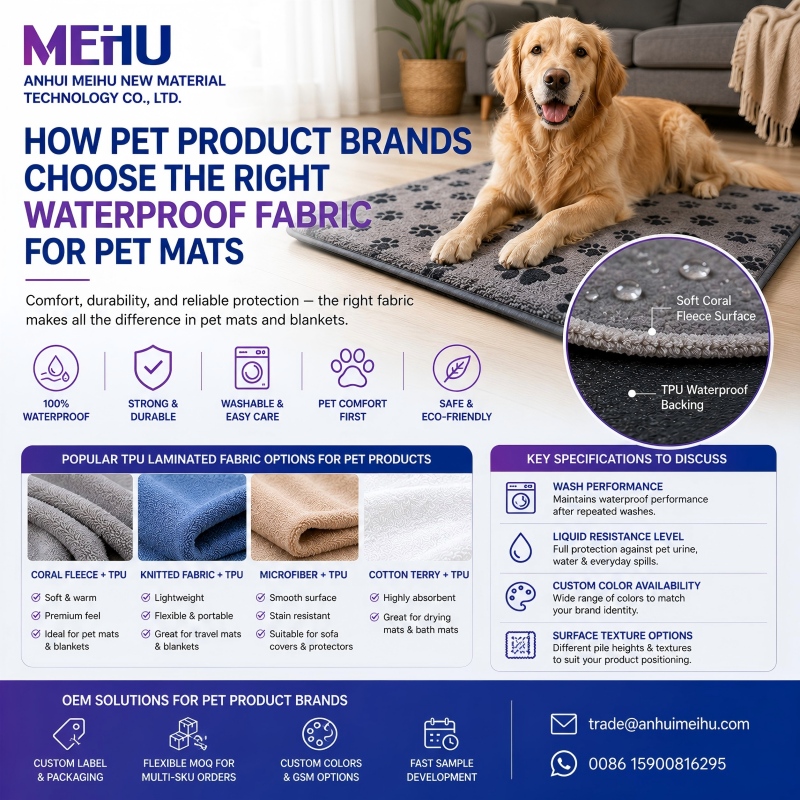
The Most Common Fabric Choice: Coral Fleece with TPU Lamination
Waterproof coral fleece fabric is the most widely used material for premium pet mats and pet blankets. The dense fleece pile provides a soft, warm surface that pets find comfortable, while the bonded TPU membrane on the reverse side prevents any liquid from passing through to the floor or furniture surface beneath.
The combination of surface softness and reliable waterproof backing makes coral fleece the natural choice for brands targeting the mid-to-premium pet market, where product quality and tactile experience are key purchase drivers.
Key considerations when sourcing coral fleece for pet applications:
Pile density — A denser, higher GSM fleece surface provides better softness and a more premium feel. Lower GSM options are lighter and easier to wash, which may suit some applications better. Discuss the right GSM range with your supplier based on your product’s intended use and price point.
Color fastness — Pet product buyers frequently request custom colors for brand alignment. Confirm color fastness performance with your supplier, as pet mats are washed frequently and color degradation is a common complaint in lower-quality products.
TPU backing durability — Pet products are typically washed more frequently and at higher temperatures than standard bedding. Confirm that the TPU lamination maintains its waterproof performance under the washing conditions your end customers are likely to use.
Alternative Fabric Options for Pet Applications
While coral fleece dominates the pet mat market, other TPU laminated fabrics serve specific pet product applications:
Knitted fabric with TPU — Lighter weight and more flexible than coral fleece, suitable for travel pet mats and portable pet blankets where packability matters more than plush surface feel.
Microfiber with TPU — Smooth surface with excellent stain resistance, suitable for washable pet sofa covers and furniture protectors where a sleek appearance is preferred over plush texture.
Cotton terry with TPU — Absorbent surface suitable for dog drying mats and bath mats where moisture absorption is the primary function rather than pure waterproof protection.
Key Specifications to Discuss with Your Supplier
When sourcing waterproof fabric for pet product applications, the following points are worth raising with your supplier:
Wash performance — Confirm the recommended wash temperature and how waterproof performance holds up over repeated wash cycles. Pet products are washed frequently, so this is a higher-priority specification than for some other applications.
Liquid resistance level — For pet urine specifically, confirm that the TPU membrane provides full barrier performance, not just water resistance. These are meaningfully different performance levels.
Custom color availability — Most pet brands have specific color requirements for brand consistency. Confirm available standard colors and the process for custom color development, including MOQ requirements.
Surface texture options — Within coral fleece, different pile heights and textures are available. Request swatches of different options before specifying, as the surface feel varies more than product photos typically convey.
OEM Considerations for Pet Product Brands
Pet product brands sourcing fabric for OEM production should clarify a few additional points beyond the standard supplier questions:
Label and packaging options — If you are building a private label pet product line, confirm whether your supplier supports custom packaging and labeling, or whether this needs to be arranged separately.
MOQ flexibility — Pet product lines often involve multiple colorways and SKUs, which can push total order volumes up while keeping per-SKU quantities relatively low. Discuss how your supplier handles multi-SKU orders and whether MOQ applies per color or per order.
Sample development timeline — If you are launching a new product line, build realistic sample development and approval time into your project timeline. Custom color samples in particular may require additional development time.
Meihu supplies waterproof coral fleece fabric and other TPU laminated fabric options for pet mat, pet blanket, and sofa protector manufacturers. Custom colors, GSM ranges, and OEM production are available. If you are developing a waterproof pet product line and would like to discuss fabric options or request samples, contact us directly.
trade@anhuimeihu.com | WhatsApp: 0086 15900816295
Post time: Jun-08-2026