
Choosing a waterproof fabric for a mattress protector may seem simple.
You need a fabric that keeps liquid away from the mattress.
But for B2B buyers, the real challenge is finding the right balance between:
Waterproof protection + comfort + breathability + durability + cost.
A fabric that performs well in one area may not necessarily be the best choice for the finished product.
For example, a healthcare mattress protector may require very different characteristics from a premium home bedding product.
So, how should buyers evaluate waterproof fabric before placing an order?
Here are the key factors to consider.
The first question should not be: “Which waterproof fabric is cheapest?”
Instead, ask: “What kind of mattress protector are we making?”
Different applications require different fabric constructions.
| Application | Important Characteristics |
|---|---|
| Home Bedding | Softness, comfort, breathability |
| Hotel Bedding | Durability, easy care, appearance |
| Nursing Care | Waterproof performance, durability, wash resistance |
| Hospital Use | Performance, durability, frequent washing |
| Premium Bedding | Soft hand feel, appearance, premium fibers |
| Budget Products | Cost efficiency, basic protection |
Understanding the final application helps determine which fabric construction makes sense.
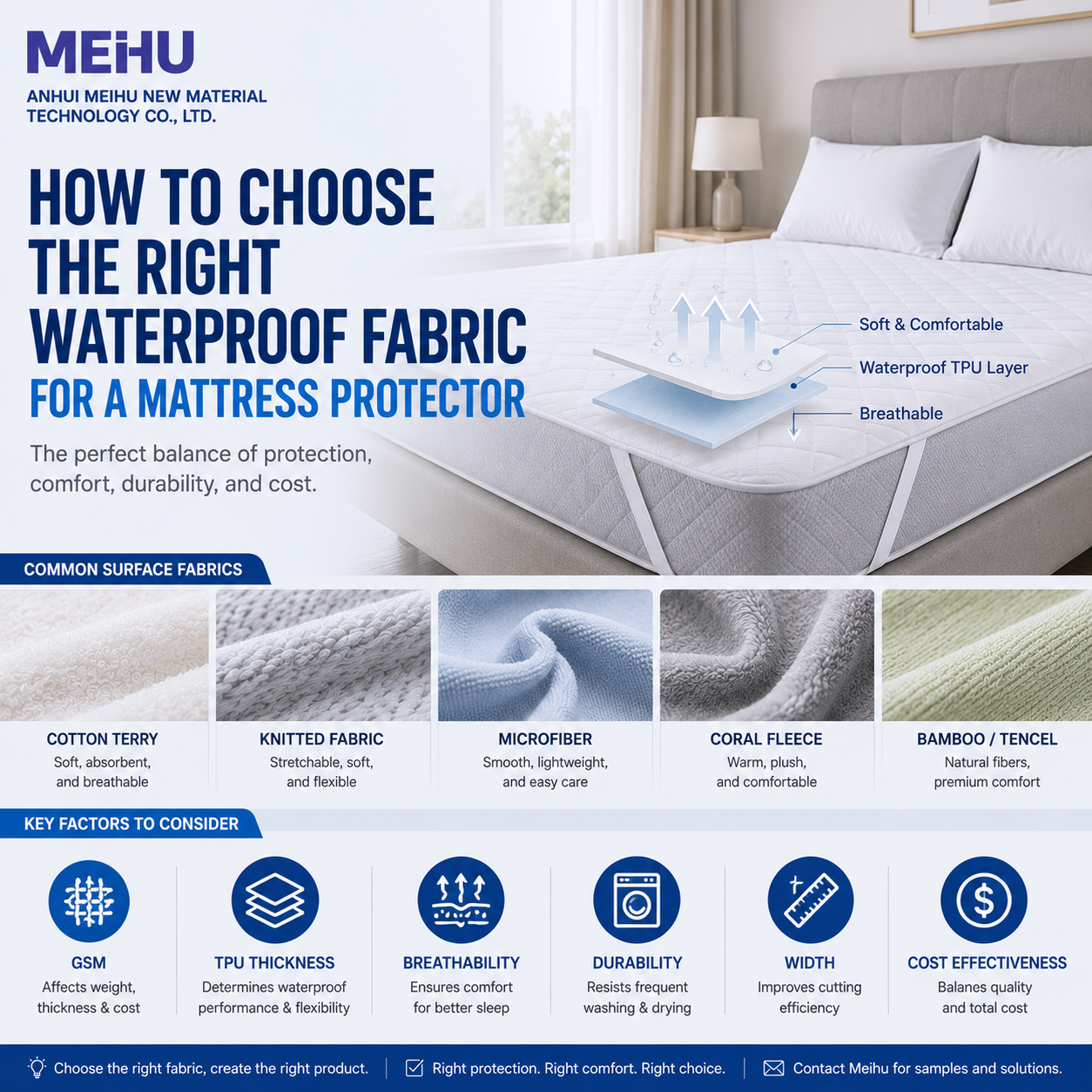
The surface of the waterproof fabric is what the user touches. It can therefore have a significant influence on the perceived quality of the mattress protector.
Common choices include:
- Cotton Terry
A traditional choice for bedding applications. It provides a soft surface and good moisture absorption. - Knitted Fabric
Knitted fabrics can offer a soft hand feel and stretch, making them suitable for fitted mattress protectors. - Microfiber
Microfiber can provide a smooth surface and lightweight construction. It is also commonly used in cost-conscious bedding products. - Coral Fleece
Coral fleece provides a warmer, plush surface and can be suitable for products designed for colder environments.
The best option depends on the positioning of your finished product.
GSM means grams per square meter. It is one of the basic specifications buyers should confirm when comparing fabrics.
Generally, GSM affects:
- Fabric weight
- Thickness
- Hand feel
- Warmth
- Cost
- Shipping weight
However, higher GSM does not automatically mean better quality. A lightweight fabric can be the better choice if your product needs to be:
- Thin
- Flexible
- Breathable
- Lightweight
- Cost-efficient
Instead of simply asking for the highest GSM, buyers should determine the appropriate GSM for the final mattress protector.
The TPU layer provides the waterproof barrier. Different applications may require different TPU specifications.
A thinner TPU layer can help create a lighter and more flexible construction. A thicker layer may provide a different balance of protection and durability.
But again: Thicker does not automatically mean better.
The right TPU specification should be determined according to the finished product, required waterproof performance, washing conditions, and target price.
A mattress protector should not only prevent liquid penetration. It should also provide an acceptable sleeping environment.
If a waterproof mattress protector feels hot or uncomfortable, consumers may dislike the product even if its waterproof performance is excellent.
Waterproof performance + moisture vapor breathability + surface comfort
For premium bedding products, breathability can be especially important.
Mattress protectors are frequently washed. For commercial, healthcare, and nursing applications, washing can be even more demanding.
Before selecting a waterproof fabric, buyers should consider:
Washing frequency
Detergent type
Drying method
Expected product lifespan
A fabric intended for occasional home use may not be suitable for intensive commercial laundry.
Therefore, always tell your supplier the expected washing conditions before selecting the construction.
Fabric width is another specification that is sometimes overlooked. For mattress protector manufacturing, the available width can affect:
- Cutting efficiency
- Fabric consumption
- Number of seams
- Production efficiency
- Material waste
For example, if your finished mattress protector requires a large cutting width, a wider fabric may reduce unnecessary material waste. So when comparing two fabrics with similar GSM and TPU specifications, don’t forget to compare their usable width.
Two waterproof fabrics may look almost identical in a quotation. For example:
- Fabric A: $X/m
- Fabric B: $X + 0.10/m
At first glance, Fabric A appears cheaper. But the real cost may depend on:
- Fabric width
- GSM
- Roll length
- Usable material
- Defect rate
- Waterproof performance
- Production consistency
- Packaging
- Shipping efficiency
A slightly higher fabric price may sometimes result in a lower overall production cost. For B2B purchasing, cost per finished product is often more meaningful than cost per meter alone.
Before ordering waterproof fabric for mattress protectors, ask your supplier to confirm:
- Composition
- GSM
- Width
- Surface construction
- Color
- TPU thickness
- Waterproof performance
- Breathability
- Lamination method
- MOQ
- Sampling time
- Lead time
- Production capacity
- Inspection procedure
- Test reports
- Certifications
- Washing performance
- Roll length
- Packaging
- Loading quantity
- Container capacity
Having these specifications confirmed before production can significantly reduce misunderstandings.
There is no single “best” waterproof fabric for every mattress protector. Instead, the right fabric depends on your product.
- Soft knitted or cotton-based fabric
- Comfortable hand feel
- Lightweight TPU
- Good breathability
- Durable fabric
- Easy care
- Reliable waterproof protection
- Cost-efficient construction
- Durable construction
- Reliable waterproof performance
- Suitable for frequent washing
- Consistent quality
The best fabric is the one that meets the requirements of the finished product.
Selecting waterproof fabric should be treated as a product-development decision, not simply a purchasing decision.
Application → Surface Fabric → GSM → TPU → Breathability → Washing → Width → Cost
At Meihu, we develop TPU laminated waterproof fabrics using different textile constructions for mattress protectors and other waterproof textile products.
If you already have a target specification, send it to us. If you don’t know exactly which construction you need, tell us about your finished product and target market.
We can help evaluate a suitable fabric construction and prepare samples for testing.
Post time: Sep-01-2026