
Receiving fabric samples is only the beginning of the evaluation process. The real work — and the real value — comes from testing those samples systematically before committing to a bulk order. Buyers who skip or rush this stage are the ones most likely to encounter quality issues after production, when the cost of resolving them is significantly higher.
This guide outlines the key tests every B2B buyer should conduct on waterproof fabric samples, what to look for in each test, and how to use the results to make a confident sourcing decision.
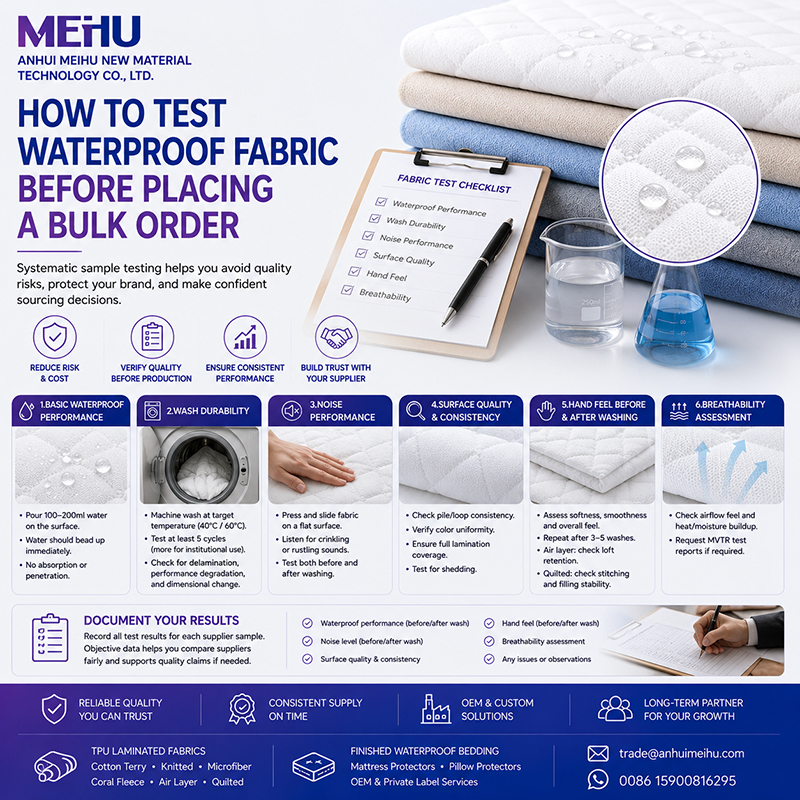
Why Sample Testing Matters More Than It Seems
A fabric sample can look and feel excellent in your hand without performing adequately in the conditions your finished product will face. Surface appearance, hand feel, and even basic water resistance can all seem satisfactory on initial inspection while underlying issues — lamination adhesion, wash durability, noise performance — only reveal themselves under testing.
The cost of thorough sample testing is minimal compared to the cost of a bulk order that fails in production or in the market. For buyers developing waterproof mattress protectors, pillow protectors, pet mats, or any finished product where waterproof performance is a core claim, sample testing is not optional — it is the foundation of a reliable sourcing decision.
TEST 1Basic Waterproof Performance
The most fundamental test is also the simplest: pour water onto the fabric surface and observe what happens.
Pour a small amount of water — approximately 100-200ml — onto the fabric surface and observe for 30-60 seconds. On a properly laminated TPU waterproof fabric, liquid should bead immediately on the surface with no penetration or spreading into the fabric structure. If liquid absorbs into the surface or passes through to the reverse side, the waterproof lamination is inadequate for bedding applications.
Test this on multiple areas of the sample, including edges and corners if applicable. Consistency across the full sample surface matters — localized failures indicate lamination quality issues that will affect the full production run.
For a more rigorous assessment, apply sustained pressure to the wet fabric surface for 30 seconds and check the reverse side for moisture penetration. This simulates the pressure conditions the fabric will face in actual use.
TEST 2Wash Durability
Waterproof performance on a fresh sample is the minimum requirement. What matters for commercial applications is whether that performance holds after repeated laundering.
Machine wash the sample at the temperature your end product will be laundered at — typically 40°C for consumer products, 60°C for hospitality and healthcare applications. After washing, allow the fabric to dry completely and repeat the basic waterproof pour test.
Repeat this process for a minimum of five wash cycles before making a sourcing decision. For institutional applications such as hotel or hospital supply, test for significantly more cycles — the wash durability requirements for commercial laundry environments are substantially higher than for domestic use.
Key indicators of wash durability problems:
Delamination — The TPU membrane separating from the base fabric, visible as bubbling, peeling, or a change in surface texture after washing.
Waterproof performance degradation — Liquid that previously beaded on the surface beginning to absorb or penetrate after washing cycles.
Dimensional change — Significant shrinkage or distortion of the fabric structure after washing, which affects fit in finished products. This is particularly relevant for cotton terry constructions.
TEST 3Noise Performance
For consumer bedding applications, noise is a critical performance factor. A waterproof mattress protector that generates crinkling or rustling sounds during sleep movement is one of the most common consumer complaints in this category, and one of the hardest to address after production.
To test noise performance: place the fabric sample on a flat surface and apply moderate pressure with your palm, then slide your hand across the surface. Repeat this while the fabric is under a light load. Listen carefully for any crinkling, crackling, or stiffness sounds.
Assess this test on both a dry sample and a sample that has been washed and dried, as TPU stiffness can change after laundering. For retail and hospitality applications where guest experience matters, this test should be a non-negotiable part of your evaluation.
Knitted TPU fabric and microfiber TPU fabric generally perform better on noise tests than heavier constructions, though this varies by TPU specification.
TEST 4Surface Quality and Consistency
Examine the fabric surface carefully under good lighting, looking for the following:
Pile consistency — For coral fleece and cotton terry fabrics, check that the pile or loop density is consistent across the full sample surface. Thin patches or uneven density indicate manufacturing inconsistency.
Color uniformity — Check for color variation across the sample. Hold the fabric up to natural light and examine for streaking, shading, or uneven dyeing. This is particularly important for custom color orders.
Lamination coverage — On the reverse side, check that the TPU membrane covers the full surface evenly with no gaps, thin patches, or visible bubbling.
Shedding — For pile fabrics, rub the surface firmly with a dark cloth and check for fiber transfer. Excessive shedding after production is a common quality complaint that is much easier to identify at the sample stage.
TEST 5Hand Feel Before and After Washing
The feel of a fabric sample fresh from the supplier and after several wash cycles can differ significantly. Assess hand feel on the initial sample, then repeat the assessment after three to five wash cycles.
For air layer fabric, check that the three-dimensional structure retains its loft and resilience after washing — compression of the spacer layer affects both feel and breathability performance.
For quilted fabric, check that the quilting stitching remains intact and that the filling maintains even distribution after washing.
TEST 6Breathability Assessment
For fabric types where breathability is a claimed performance feature — particularly air layer TPU fabric — a basic comparative breathability assessment is worth conducting.
Hold the fabric against a light source and observe the degree of light transmission through the structure. While this is not a substitute for laboratory testing, significant differences in breathability between fabric types are generally visible this way. For a more practical assessment, wear the fabric against skin for several minutes and compare the heat and moisture buildup sensation against a non-breathable alternative.
For buyers requiring certified breathability data, request moisture vapor transmission rate (MVTR) test reports from your supplier.
Meihu provides fabric samples for evaluation across our full range of TPU laminated constructions, including cotton terry, knitted, microfiber, coral fleece, air layer, and quilted fabrics. Contact us to request samples and discuss your evaluation requirements.
Post time: Jun-22-2026