
When a customer places a large waterproof fabric order, production is only part of the job.
The next challenge is making sure hundreds of rolls arrive at their destination safely, in good condition, and with the correct quantity and specifications.
For international B2B buyers, container loading is therefore an important part of the supply process.
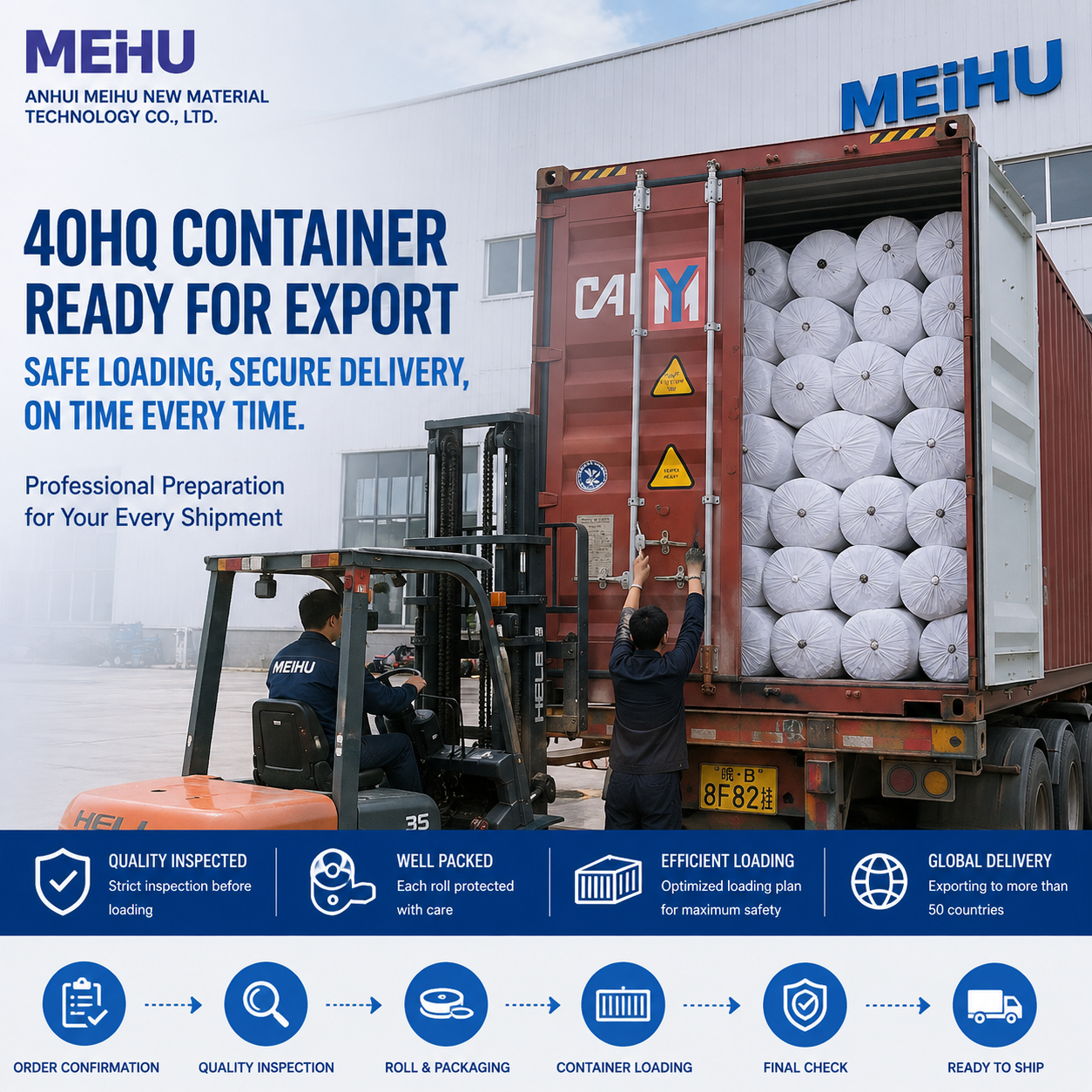
At Meihu, we regularly prepare waterproof fabric orders for export to customers in different markets. A typical 40HQ container may contain a large number of fabric rolls, so careful planning is required before the container arrives.
Here is how we prepare a 40HQ shipment from finished fabric to final loading.
1. Confirming the Order Before Loading
Before preparing the shipment, we first check the confirmed order information.
This normally includes:
Product type
Fabric composition
GSM
Width
TPU specification
Color
Roll length
Total quantity
Packaging requirements
Customer labels
Shipping marks
For customized OEM orders, these details are especially important because different products may have different packaging and identification requirements.
The loading plan is prepared according to the actual order rather than simply filling the container with as much material as possible.
2. Final Inspection of Finished Fabric
Before the products enter the container, finished rolls are checked according to the agreed specifications.
The inspection may include:
Fabric appearance
Width
Roll length
Lamination quality
Color consistency
Packaging condition
Quantity
For waterproof laminated fabrics, maintaining consistent lamination quality is particularly important.
A container may travel thousands of kilometers by sea, so identifying potential problems before shipment is much better than discovering them after the goods arrive.
3. Preparing the Fabric Rolls
After inspection, the finished fabric is organized into rolls.
Depending on the customer’s requirements, rolls may be protected with PE film or other suitable packaging.
Each roll should be clearly identifiable.
Labels may include information such as:
Product code
Color
Width
Roll number
Length
Customer information
Good labeling makes receiving and warehouse management much easier for the customer.
4. Planning the Container Loading
A 40HQ container provides substantial loading capacity, but available space still needs to be used efficiently.
Before loading begins, our team considers:
Roll dimensions
Roll weight
Packaging
Product type
Quantity
Loading sequence
Container capacity
The objective is not simply to maximize the number of rolls.
We also need to consider the stability and safety of the cargo during transportation.
A well-planned loading arrangement can help reduce unnecessary movement inside the container.
5. Loading the Container
Once the container arrives, the loading process begins.
Workers move the prepared rolls into the container according to the loading plan.
Depending on the order, different loading methods may be used.
The team pays attention to:
Weight distribution
Roll positioning
Available space
Packaging condition
Product protection
For larger shipments, an organized loading sequence is particularly important because the position of each group of products can affect the efficiency of unloading at the destination.
6. Protecting the Cargo During Transportation
International sea transportation can take weeks.
During this time, the cargo may experience:
Vibration
Movement
Temperature changes
Humidity
Multiple handling operations
That’s why proper packaging and loading are important.
The goal is to keep the fabric rolls stable and protected throughout transportation.
For waterproof textile products, protecting the outer packaging is also important because damaged packaging can expose the fabric to dust, moisture, and handling damage.
7. Checking the Container Before Closing
After all goods have been loaded, the team performs a final check.
We verify:
Product quantity
Roll numbers
Loading arrangement
Packaging condition
Container condition
Shipping marks
Only after the final inspection is completed is the container ready to be closed.
This final check provides one more opportunity to identify discrepancies before the shipment leaves the factory.
8. Documentation and Shipment Preparation
Container loading is closely connected with export documentation.
Depending on the order and shipping arrangement, relevant information may include:
Commercial invoice
Packing list
Shipping information
Product description
Roll quantity
Gross and net weight
Container information
Accurate information helps reduce communication problems between the manufacturer, freight forwarder, customs broker, and customer.
For B2B shipments, accuracy is just as important as physical product quality.
Why Container Loading Matters to B2B Buyers
When comparing waterproof fabric suppliers, buyers often focus on price, GSM, TPU thickness, and waterproof performance.
But logistics capability also matters.
A supplier may manufacture good fabric but still create problems through:
Poor packaging
Inaccurate roll quantities
Unclear labels
Inefficient container loading
Inconsistent documentation
For long-distance international orders, these details can affect the customer’s receiving process and overall purchasing experience.
That’s why we consider shipment preparation part of the manufacturing service—not something that begins only after production is finished.
How We Prepare for a Large OEM Shipment
For a customized OEM order, the process can be summarized as:
Order Confirmation
↓
Production
↓
Quality Inspection
↓
Roll Preparation
↓
Packaging & Labeling
↓
Container Loading Plan
↓
40HQ Loading
↓
Final Inspection
↓
Export Documentation
↓
Shipment
Each step provides an opportunity to confirm that the order is ready for the next stage.
What Should Buyers Confirm Before a Container Shipment?
If you are purchasing waterproof fabrics internationally, it is useful to confirm several details with your supplier before shipment:
Product
Is the final specification confirmed?
Does the finished product match the approved sample?
Quantity
Are roll quantities and lengths clearly recorded?
Is the total quantity consistent with the order?
Packaging
How is each roll protected?
Is customized packaging available?
Labeling
Are roll numbers and product codes included?
Can customer-specific labels be used?
Loading
How will the goods be arranged inside the container?
Can loading photos or videos be provided?
Documentation
Are the packing list and commercial invoice consistent with the actual shipment?
These questions can help reduce misunderstandings and make the receiving process easier.
From Our Factory to Your Warehouse
For us, the job doesn’t end when the waterproof fabric comes off the production line.
A successful order means the right product is:
Produced correctly → Inspected carefully → Packed properly → Loaded safely → Delivered successfully
That’s especially important for international B2B customers who may be thousands of kilometers away from the factory.
At Meihu, we manufacture TPU laminated waterproof fabrics for mattress protectors, pillow protectors, healthcare products, hospitality applications, and other waterproof textile products.
Whether you need a few sample rolls or a full 40HQ container, we can work with you on product specifications, OEM development, production, quality control, packaging, and export preparation.
Have a waterproof fabric project in mind? Contact Meihu to discuss your requirements and request a quotation or sample.
Post time: Aug-25-2026