
For buyers sourcing waterproof fabric or finished waterproof bedding products from a manufacturer for the first time, three questions come up consistently: What is the minimum order quantity? How long will production take? And what does the sampling process look like?
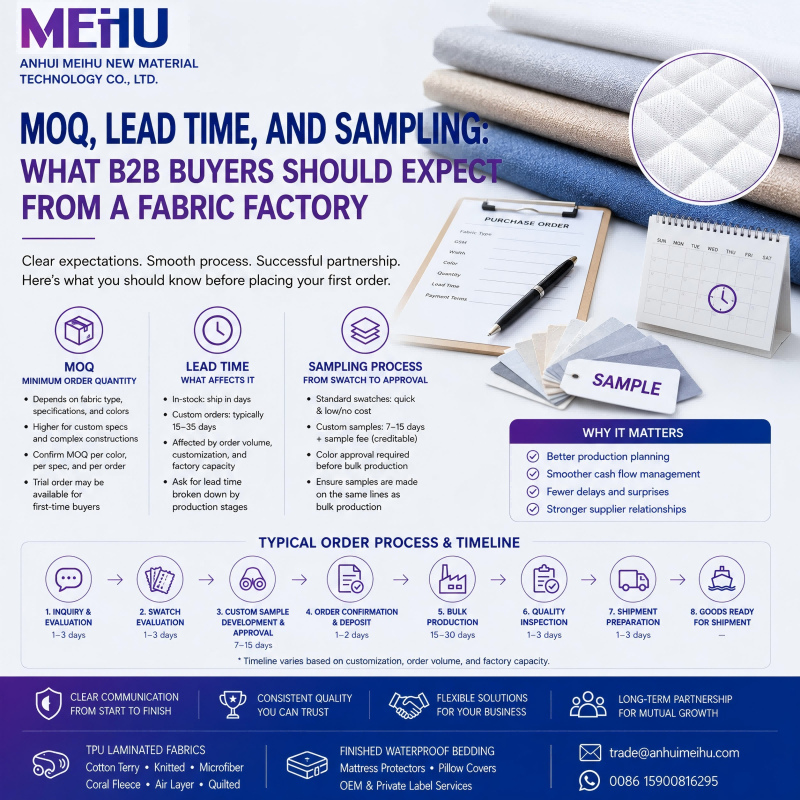
These are reasonable, practical questions — and the answers matter significantly for production planning, cash flow, and timeline management. This guide outlines what realistic expectations look like when working with a fabric manufacturer, and what to watch for when evaluating supplier responses.
Understanding MOQ: What It Is and Why It Varies
MOQ — minimum order quantity — is the smallest order volume a manufacturer will accept for a given product. It exists because manufacturing involves fixed setup costs: preparing equipment, mixing dyes, configuring lamination lines, and scheduling production runs all require time and resources regardless of how large the order is.
For TPU laminated waterproof fabrics, MOQ is typically expressed in meters per color or per specification. For finished products such as waterproof mattress protectors, MOQ is usually expressed in pieces per size or per style.
MOQ varies depending on several factors:
Fabric Type
More complex constructions such as air layer fabric or quilted fabric typically carry higher MOQs than simpler constructions like knitted fabric or microfiber, due to more involved production processes.
Custom vs Standard Specifications
Standard specifications (common GSM, standard colors, stock widths) typically carry lower MOQs because they can be consolidated with other orders. Fully custom specifications — unique colors, non-standard widths, custom TPU formulations — require dedicated production runs and therefore higher MOQs.
Supplier Type
Manufacturers generally have higher MOQs than trading companies, but offer better pricing per unit and more control over quality and customization. Trading companies may offer lower entry thresholds but with less flexibility on specification.
What to ask: Always confirm MOQ per color, per specification, and per order — these are three different numbers and conflating them leads to mismatched expectations. Also ask whether trial order arrangements are available for first-time buyers, as some manufacturers offer flexibility to establish the relationship before committing to full MOQ volumes.
Lead Time: What the Timeline Actually Looks Like
Lead time in fabric manufacturing is the period from order confirmation to ready-to-ship product. Understanding what happens during this period helps you build realistic timelines into your production planning.
A typical production lead time for TPU laminated fabric involves several sequential stages: raw material procurement, production scheduling, fabric knitting or weaving, TPU lamination, quality inspection, and packaging. Each stage has its own timeline, and delays at any point extend the overall lead time.
Key factors that affect lead time:
In-Stock vs Make-to-Order
Some suppliers maintain stock of standard specifications, which can ship within days. Custom orders require full production lead time. Confirm whether the specification you need is available from stock or requires production.
Order Volume
Larger orders typically require longer production runs. However, very small orders may also take longer if they need to be scheduled around larger production commitments.
Customization Complexity
Custom colors require dye development and color approval before production begins. Custom widths or TPU specifications may require equipment adjustment. Each adds time to the overall timeline.
Factory Capacity
Lead times fluctuate based on the factory’s current order load. During peak periods such as pre-holiday production seasons, lead times extend across the industry. Ask your supplier for current lead time at the time of inquiry, not the theoretical minimum.
What to ask: Request lead time broken down by stage — sample approval, production, inspection, and shipment preparation. This gives you visibility into where delays are most likely to occur and helps you identify which stage to monitor most closely.
The Sampling Process: What to Expect
Sampling is the stage between initial inquiry and bulk order commitment. A well-managed sampling process protects both buyer and supplier by confirming that the final product meets specification before full production begins.
For TPU laminated fabrics, sampling typically works as follows:
Standard Swatches
Most manufacturers can provide standard fabric swatches from existing production for initial evaluation. These are usually available quickly and at low or no cost, and are suitable for assessing basic hand feel, surface texture, and general waterproof performance.
Custom Development Samples
If you require a specific GSM, color, or construction that isn’t in the supplier’s standard range, a custom development sample requires a dedicated production run. This takes longer and may involve a sample fee. The sample fee is often credited against the bulk order if you proceed.
Approval Process
For custom colors, a color approval stage is typically required before bulk production begins. The supplier produces a strike-off or lab dip for your review, and bulk production only proceeds once you confirm the color match. Allow time for this in your project timeline.
What to evaluate in samples:
- Surface quality and consistency
- Waterproof performance under water pressure
- Hand feel and noise level
- Dimensional stability after washing
- Color accuracy against your specification
- For cotton terry and coral fleece fabrics, also evaluate pile consistency and shedding after washing
What to ask: Confirm whether samples will be produced from the same equipment and materials as bulk production — not from a separate sample line. This matters more than most buyers initially appreciate.
Putting It Together: A Realistic Timeline
For buyers planning their first order from a new supplier, a realistic timeline from initial inquiry to goods ready for shipment might look something like this:
The total elapsed time varies significantly depending on whether custom specifications are involved, how quickly approval stages can be completed, and the supplier’s current production load. Buyers who have done thorough preparation before contacting suppliers — clear specifications, defined evaluation criteria, prompt feedback on samples — consistently move through this process faster than those who are still refining requirements mid-process.
At Meihu, we supply TPU laminated fabrics including cotton terry, knitted, microfiber, coral fleece, air layer, and quilted constructions, as well as finished waterproof mattress protectors and pillow covers with OEM and private label services.
Contact us to discuss your requirements or request samples.
trade@anhuimeihu.com | WhatsApp: 0086 15900816295
Post time: Jun-12-2026