
Introduction
When sourcing waterproof textile materials, B2B buyers often encounter two product descriptions: PU-coated fabric and TPU-laminated fabric.
Both are used in functional textile applications, including mattress covers, waterproof bedding, protective products, and furniture-related products. However, they are not necessarily made using the same construction or manufacturing process.
One important point is that TPU stands for thermoplastic polyurethane. Therefore, PU and TPU are related polymer terms. In textile sourcing, the distinction between conventional PU-coated fabric and TPU film-laminated fabric is often about how the functional layer is formed and attached to the textile.
Understanding this difference helps manufacturers choose the right material, specify the correct construction, and compare supplier quotations more accurately.
This guide explains the main differences and provides practical sourcing advice for B2B buyers.
1. What Is PU-Coated Fabric?
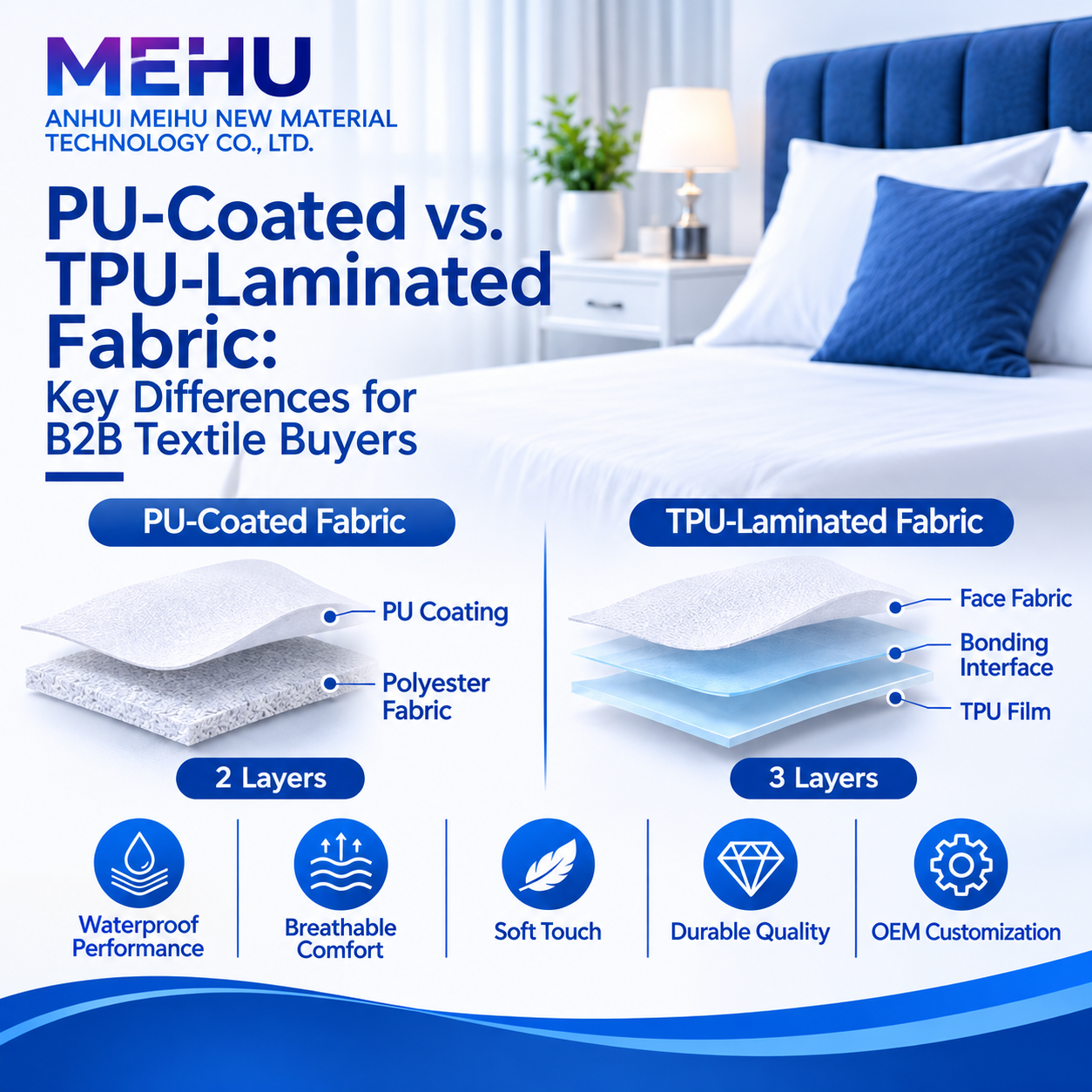
PU-coated fabric is a textile material with a polyurethane coating applied to its surface.
In a common direct-coating process, a liquid PU formulation is applied to the surface of a base fabric. The material then goes through the required drying and curing stages to form a functional coating layer.
The typical construction consists of:
Base fabric: Often polyester or another suitable textile substrate.
PU coating: A polyurethane layer applied to the textile surface.
Optional finishing: Additional treatments or finishing operations according to the product requirements.
The base fabric provides the textile structure, while the PU coating contributes the required surface properties.
The performance depends on factors such as the PU formulation, coating weight, substrate, adhesion, and processing conditions.
PU-Coated Polyester Fabric from Meihu
Meihu offers three PU-coated polyester fabric constructions for different applications.
Product PU Coating Polyester Backing Total Weight Application
Standard 80 GSM 120 GSM Approx. 200 GSM Medical mattress covers
Heavy-Duty 100 GSM 140 GSM Approx. 240 GSM Medical mattress covers
Lightweight 70 GSM 100 GSM Approx. 170 GSM Home and furniture products
These specifications illustrate why buyers should compare coating weight and backing weight separately rather than looking only at total GSM.
For customized projects, fabric width, color, total weight, and application requirements should also be confirmed.
2. What Is TPU Film-Laminated Fabric?
TPU film-laminated fabric combines a textile substrate with a separate thermoplastic polyurethane membrane.
In a typical film-lamination construction, the TPU film is bonded to the textile using a suitable adhesive or thermal bonding process, depending on the selected materials and manufacturing method.
The basic construction consists of:
Face fabric: The textile surface, which may be knitted, woven, terry, or another suitable construction.
TPU film: A separate membrane that provides the intended functional barrier.
Bonding interface: The layer or process that joins the membrane and textile together.
The resulting composite fabric combines the characteristics of the textile surface with the performance requirements of the TPU membrane.
TPU-laminated fabrics are commonly considered for waterproof bedding products, mattress protectors, fitted sheets, pillow protectors, and other protective textile applications.
The actual performance depends on the selected membrane, fabric substrate, bonding process, and test requirements.
3. PU Coating vs. TPU Film Lamination: Main Differences
Although both material constructions involve polyurethane-based materials, their manufacturing approaches can be different.
The following table compares common textile constructions used in B2B sourcing.
Comparison PU-Coated Fabric TPU Film-Laminated Fabric
Functional layer PU coating formulation Separate TPU film or membrane
Application process Coating applied directly or through a transfer-coating process Film bonded to textile substrate
Construction Textile plus formed coating layer Textile plus membrane and bonding interface
Main specifications Coating weight, backing weight, total GSM Film thickness, substrate GSM, bonding construction
Surface feel Depends on formulation and coating amount Depends on face fabric, film, and bonding method
Flexibility Depends on coating formulation and substrate Depends on membrane thickness, substrate, and bonding
Waterproof performance Must be confirmed by relevant testing Must be confirmed by relevant testing
Breathability Depends on coating design and formulation Depends on membrane technology and complete construction
Quality control Coating consistency and adhesion Film consistency and lamination bonding
Neither construction is automatically better in every application.
The appropriate choice depends on the product design, required performance, production process, and target cost.
4. Waterproof Performance: What Should Buyers Consider?
For waterproof textile materials, the important question is not simply whether the product is PU-coated or TPU-laminated.
Buyers need to define the required resistance to liquid penetration and confirm it through relevant testing.
For example, when developing waterproof mattress covers or mattress protectors, consider:
Required hydrostatic pressure performance.
Coating or membrane thickness.
Uniformity of the functional layer.
Adhesion between the layers.
Performance after repeated washing, where applicable.
Seam and finished-product performance.
A coating or membrane may provide a liquid barrier, but the final result depends on the complete material construction.
For products with sewn seams, the finished item may require additional construction measures and testing.
Do not assume that all PU-coated or TPU-laminated fabrics have the same waterproof performance simply because they use the same polymer family.
5. Comfort, Flexibility, and Breathability
The textile surface and functional layer work together to determine the material’s overall feel.
For bedding applications, buyers often need to balance waterproof performance with flexibility and comfort.
Surface Feel
The face fabric is important because it is the part that users may directly touch. Options such as knitted polyester, microfiber, and cotton terry can produce different surface characteristics.
Flexibility
The base fabric and functional layer both affect how easily the material bends, stretches, and adapts to a product’s shape.
For fitted sheets, flexibility and stretch recovery may be particularly important.
Breathability
Breathability should be specified carefully. It depends on the coating or membrane system and the complete material construction.
If water vapor transmission is important to your project, request relevant test data and confirm the testing method. Do not assume that a waterproof material is automatically breathable.
For B2B buyers, the best approach is to evaluate samples under the actual product requirements.
6. Which Material Is Suitable for Different Applications?
The material should be selected according to the finished product rather than according to the name alone.
PU-Coated Fabric for Medical Mattress Covers
Meihu offers two PU-coated constructions for medical mattress cover applications:
Standard: Approx. 200 GSM.
Heavy-Duty: Approx. 240 GSM.
They have different PU coating and polyester backing weights, allowing buyers to select a suitable construction according to their project specifications.
Medical applications may have additional cleaning, mechanical, chemical, or regulatory requirements. Buyers should provide the relevant requirements and arrange appropriate testing.
A general PU-coated fabric description does not automatically establish compliance with medical product standards.
PU-Coated Fabric for Home and Furniture Products
Meihu’s lightweight PU-coated polyester fabric has an approximate total weight of 170 GSM.
It is intended for home and furniture-related product applications.
Buyers can evaluate the PU coating weight, polyester backing, fabric width, color, and required performance according to the finished product design.
TPU-Laminated Fabric for Waterproof Bedding
TPU film-laminated fabrics are an important material option for waterproof bedding products.
Potential applications include:
Waterproof mattress protectors.
Waterproof fitted sheets.
Waterproof mattress covers.
Waterproof pillow protectors.
Protective bedding for hospitality and care-related applications.
Different face fabrics can be considered according to the required surface feel and product construction.
For fitted sheets, the fabric’s stretch and recovery should also be evaluated alongside the TPU membrane and finished-product seam construction.
7. How to Choose Between PU-Coated and TPU-Laminated Fabric
Before requesting a quotation, buyers should consider the following questions.
1. What is the final application?
Identify whether the material will be used for a medical mattress cover, furniture product, waterproof fitted sheet, mattress protector, or another application.
2. What construction is required?
Clarify whether the project requires a surface PU coating or a textile bonded with a TPU film.
3. What performance is essential?
Specify waterproof performance, mechanical strength, cleaning requirements, and any required breathability criteria.
4. What material specifications are important?
For PU-coated fabric, confirm coating weight, backing composition, backing GSM, and total GSM.
For TPU-laminated fabric, confirm face fabric composition, membrane thickness, total GSM, and bonding requirements.
5. What does the finished product require?
Consider stretch, flexibility, cutting, sewing, seam sealing, and other converting requirements.
6. What testing is needed?
Agree on the relevant test methods and acceptance criteria before sample approval.
7. What are the commercial requirements?
Confirm usable width, color, MOQ, estimated delivery schedule, and customized packaging where required.
Providing these details allows manufacturers to recommend a suitable material instead of quoting products that may have different constructions.
8. Working with Meihu for PU-Coated and TPU-Laminated Fabric
Anhui Meihu New Material Technology Co., Ltd. supplies waterproof textile materials and finished waterproof bedding products for B2B customers.
Our material range includes both PU-coated polyester fabric and TPU-laminated waterproof fabric.
For PU-coated polyester fabric, our current range covers:
Approx. 200 GSM standard construction for medical mattress covers.
Approx. 240 GSM heavy-duty construction for medical mattress covers.
Approx. 170 GSM lightweight construction for home and furniture products.
For TPU-laminated materials, we offer different textile surface options for waterproof bedding applications.
We support discussions about material composition, fabric weight, membrane or coating specifications, customization, sampling, and bulk purchasing.
When contacting our team, please provide the intended application and target specifications so we can evaluate the appropriate material construction for your project.
Conclusion
PU-coated fabric and TPU film-laminated fabric are two different approaches to developing functional waterproof textiles.
PU-coated fabric uses a polyurethane coating layer formed on the textile, while TPU film lamination bonds a separate TPU membrane to a fabric substrate.
The right choice depends on the application, material construction, required performance, manufacturing process, and budget.
For B2B buyers, comparing the complete specifications and testing samples before bulk purchasing is more reliable than choosing a material based on its name alone.
Anhui Meihu New Material Technology Co., Ltd. supplies PU-coated polyester fabric and TPU-laminated waterproof materials for different product applications.
Contact our team to discuss your material requirements, customized specifications, and sampling.
Email: trade@anhuimeihu.com
Website: www.meihumaterial.com
Post time: Nov-18-2026