
When developing a waterproof mattress protector or other waterproof bedding product, the waterproof membrane is an important part of the construction.
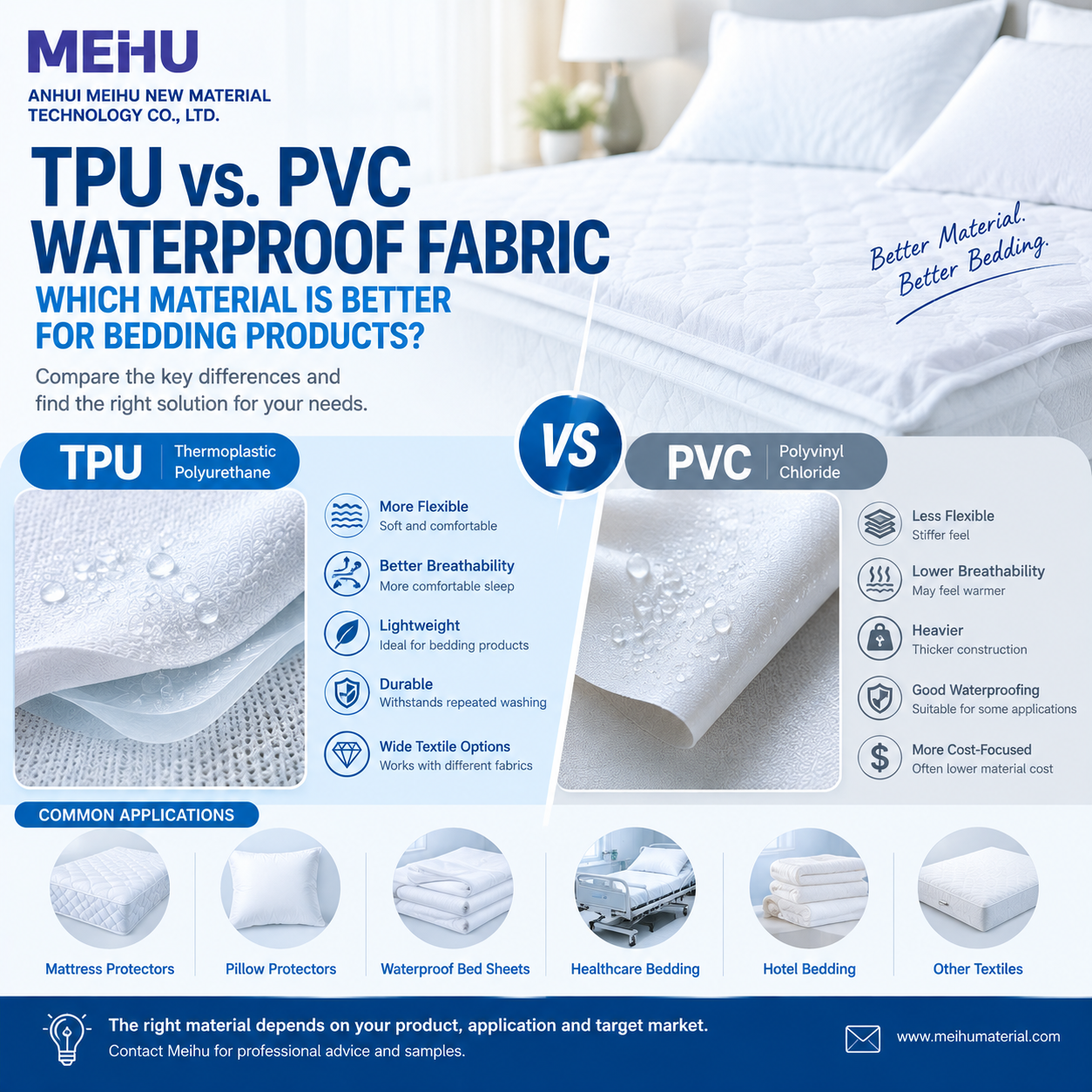
Two materials buyers may encounter are TPU and PVC. Both can provide waterproof protection, but they have different characteristics that can affect the finished product.
For bedding applications, the question isn’t simply which material is waterproof.
The more important question is: Which material provides the right balance of protection, comfort, flexibility, and product requirements?
Let’s compare the two.
1
TPU Is More Flexible
TPU stands for Thermoplastic Polyurethane. One of its advantages is its flexibility.
When laminated to textile fabrics, TPU can create a soft and flexible composite that works well for products such as:
- • Mattress protectors
- • Pillow protectors
- • Waterproof bed sheets
- • Healthcare bedding
- • Incontinence products
This flexibility is useful when the finished product needs to move with the mattress rather than feel stiff.
PVC can also be made into flexible films, but the overall hand feel and flexibility depend heavily on the specific formulation and construction.
2
TPU Can Provide a Softer Hand Feel
For bedding products, comfort matters. The user may directly touch the textile surface, and the waterproof layer can also influence the overall flexibility of the product.
TPU laminated fabrics can be developed with a relatively soft and flexible construction.
This makes TPU particularly suitable for products where waterproof protection needs to be combined with a comfortable textile feel. For a mattress protector, this can be an important consideration.
3
Breathability Is an Important Difference
Waterproof does not necessarily mean completely sealed. Some TPU waterproof membrane constructions can be designed to allow moisture vapor transmission while preventing liquid water from passing through.
Breathability is particularly relevant for:
- • Mattress protectors
- • Pillow protectors
- • Nursing care bedding
- • Products used in warm climates
PVC waterproof constructions may provide effective liquid protection, but buyers should evaluate the specific construction and performance requirements rather than assuming all waterproof materials behave the same way.
4
TPU Is Well Suited to Textile Lamination
TPU can be laminated with many different textile surfaces. For example:
Cotton Terry + TPU
Knitted Fabric + TPU
Microfiber + TPU
Coral Fleece + TPU
This allows manufacturers to create different combinations of softness, stretch, warmth, appearance, and waterproof protection. The textile surface can therefore be selected according to the finished product, while the TPU layer provides the waterproof barrier.
5
Consider the Intended Washing Conditions
Bedding products are washed frequently. Commercial products can face even more demanding washing conditions. When comparing TPU and PVC, buyers should therefore consider:
- • Washing temperature
- • Washing frequency
- • Detergents
- • Drying conditions
- • Expected service life
Material selection should always be validated through appropriate testing for the intended application. There is no substitute for testing the actual finished construction.
6
TPU Can Be a Good Choice for Premium Bedding
For customers targeting a higher-quality bedding product, the combination of a soft textile surface and TPU waterproof layer can be attractive. For example:
Tencel + TPU | Bamboo Fabric + TPU | Cotton Terry + TPU
can be developed for different product positioning. The objective is to provide waterproof protection without making the finished product feel like a traditional plastic sheet.
7
What About PVC?
PVC still has applications where waterproof protection and cost are important considerations. It can be suitable for certain products and environments.
However, when developing a product that will be used directly with bedding or textiles, buyers should consider more than waterproof performance. Important questions include:
- • How does the material feel?
- • How flexible is the finished product?
- • Does the construction meet the desired breathability requirements?
- • How will it perform after repeated washing?
- • Does it fit the positioning of the final product?
- • What certifications or material requirements does the target market have?
These questions help determine whether TPU, PVC, or another construction is appropriate.
TPU vs PVC: A Practical Comparison
| Factor | TPU | PVC |
|---|---|---|
| Waterproof protection | Excellent | Excellent |
| Flexibility | Generally high | Depends on formulation |
| Soft hand feel | Suitable for soft textile constructions | Depends on construction |
| Textile lamination | Widely used | Widely used |
| Breathable constructions | Available | More limited depending on construction |
| Bedding applications | Very suitable | Application dependent |
| Custom textile combinations | Flexible | Available |
| Cost | Usually higher | Often more cost-focused |
Actual performance depends on the specific material, thickness, formulation, lamination process, and finished construction.
So, Which One Should You Choose?
There isn’t one universal answer.
If your priority is: Softness + flexibility + textile comfort + waterproof protection
TPU may be a strong option to consider.
TPU may be a strong option to consider.
If your priority is primarily: Waterproof protection + cost efficiency
PVC may be suitable for some applications.
PVC may be suitable for some applications.
The right choice ultimately depends on the finished product and target market.
Why the Complete Fabric Construction Matters
One common mistake is comparing only the waterproof membrane. A finished waterproof fabric is a combination of several elements:
Face Fabric
↓
Lamination System
↓
Waterproof Membrane
↓
Finished Product
Changing the face fabric can completely change the feel and performance of the final product. That’s why a good supplier should evaluate the complete fabric construction, not just the membrane material.
Final Thoughts
For modern bedding products, waterproof protection is only one part of the equation. Buyers also need to consider: Comfort, Flexibility, Breathability, Washing durability, Material requirements, and Cost.
TPU laminated fabric offers manufacturers a flexible platform for developing waterproof bedding products with different textile surfaces and specifications.
At Meihu, we develop and manufacture TPU laminated waterproof fabrics for mattress protectors, pillow protectors, healthcare products, nursing care products, hospitality applications, and other waterproof textile products.
If you’re deciding between TPU and PVC for your next product, send us your application and requirements.
We can help you evaluate a suitable fabric construction and provide samples for testing.
Contact Meihu to discuss your project.
Post time: Sep-09-2026