
Baby bedding is among the most carefully scrutinized product categories in the textile market. Parents purchasing mattress covers, fitted sheet protectors, and changing mat covers for infants apply significantly higher scrutiny to material safety than they would for adult bedding — and rightly so. For manufacturers and brand buyers developing waterproof products for the baby market, the fabric specification decisions you make have direct implications for product safety, regulatory compliance, and brand trust.
This guide covers the key safety considerations, certification requirements, and material selection principles for manufacturers sourcing waterproof fabric for baby and infant product applications.
Why Baby Products Require a Higher Standard
Infants spend more time in contact with their bedding surfaces than almost any other consumer group — often twelve hours or more per day in the early months. The skin of newborns and young infants is significantly more permeable than adult skin, which means that chemical exposure through prolonged skin contact is a more meaningful risk factor in this age group.
Additionally, infants cannot regulate their own body temperature as effectively as adults, making breathability and heat management more important in baby bedding applications than in standard adult products.
These factors combine to make material safety and breathability the two most critical specification considerations for waterproof fabric used in baby products.
Safety Standards and Certifications
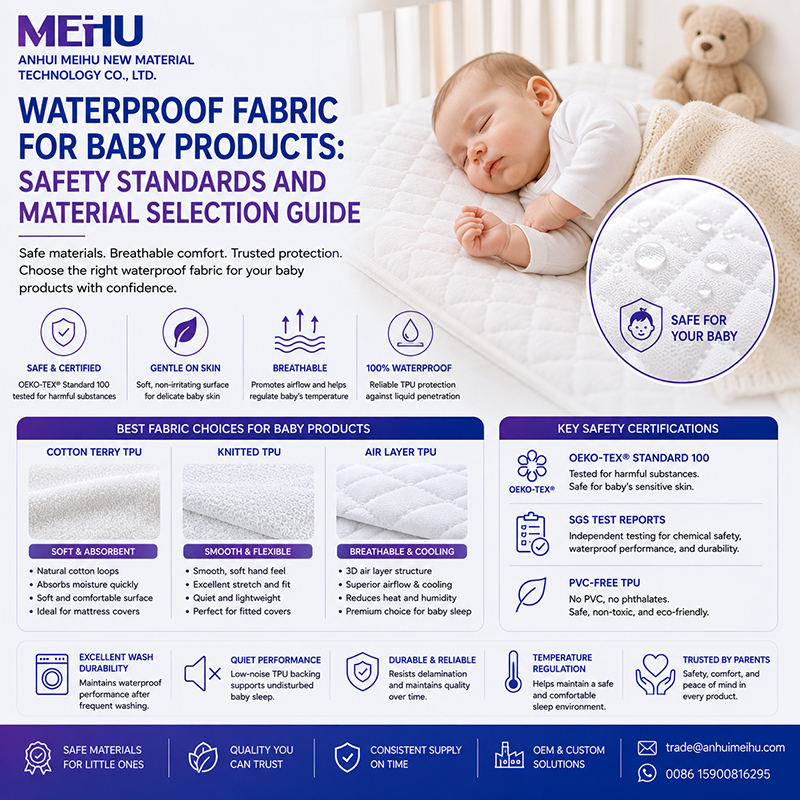
OEKO-TEX Standard 100
OEKO-TEX Standard 100 is the most widely recognized textile safety certification for baby products. It tests for a comprehensive list of harmful substances including heavy metals, pesticides, formaldehyde, phthalates, and a range of chemical compounds that may be present in fabric dyes, finishing agents, or backing materials.
Critically for waterproof fabric, OEKO-TEX Standard 100 includes specific testing of the TPU membrane layer — not just the surface textile. This matters because the TPU backing is in close proximity to the infant even when the product is functioning correctly, and chemical migration through the membrane is a potential concern with lower-quality TPU formulations.
For baby product manufacturers, OEKO-TEX Standard 100 certification should be treated as a minimum requirement rather than an optional premium. Many retail buyers and marketplace platforms in Europe, North America, and Australia now require this certification for products in the baby category.
Material Selection for Baby Waterproof Products
Surface fabric considerations
The surface fabric — the layer in direct contact with the infant — should be soft, non-irritating, and free of rough textures, loose fibers, or surface treatments that could cause skin irritation.
Cotton terry TPU laminated fabric is one of the most widely used surface materials for baby mattress covers. The natural cotton loops provide a soft, familiar texture, and the inherent absorbency of cotton helps manage surface perspiration in warm sleeping environments. Cotton’s natural composition also aligns well with the preference many parents have for natural materials in products used close to their baby’s skin.
Knitted TPU fabric is also suitable for baby applications where a smoother, more conforming surface is preferred. The flexibility of knitted constructions is particularly useful for fitted cot and crib mattress covers where a secure, wrinkle-free fit matters for both safety and comfort.
For brands positioning in the premium baby segment, bamboo-blend surface fabrics offer a natural material story with additional softness credentials that resonate well with health-conscious parent consumers.
Breathability considerations
Heat management in infant sleep environments is a subject of significant parental concern. A non-breathable waterproof cover that traps heat around a sleeping infant is a product experience problem even when it functions correctly as a waterproof barrier.
Air layer TPU fabric offers a meaningful breathability advantage for baby mattress cover applications. The three-dimensional spacer structure promotes airflow and reduces heat accumulation, which is a genuine functional benefit in this product category — not just a marketing claim. For premium baby bedding brands, this is a differentiating feature worth investing in.
TPU membrane specification
The quality and formulation of the TPU membrane matters more for baby products than for most other applications. Specifically:
PVC-free — All TPU used in baby products should be PVC-free. PVC-based waterproof membranes may contain phthalate plasticizers that are restricted in baby products under regulations in the EU, UK, and many other markets. High-quality TPU membranes do not contain PVC or phthalates by definition, but it is worth confirming this explicitly with your supplier and requesting documentation.
Noise performance — A TPU membrane that generates noise during infant movement can disrupt sleep. For baby products, silent TPU performance is as important as it is for adult premium bedding. Test samples for noise before specifying at scale.
Thickness and flexibility — Thinner TPU films (in the 15-20 micron range typically used for bedding) provide better flexibility and breathability than thicker industrial-grade films. Confirm that the TPU specification used for baby products is appropriate for soft bedding applications.
Wash Performance for Baby Products
Baby bedding is washed frequently — often multiple times per week. The wash durability requirements for baby mattress covers are therefore higher than for standard adult consumer bedding.
Test samples through multiple wash cycles at the temperature your end customer is likely to use, and confirm that both the waterproof performance and surface quality are maintained. Surface pilling, texture changes, or lamination degradation after washing are all more noticeable and more problematic in baby products where the quality expectation is high.
Confirm the recommended care instructions with your supplier and ensure these are clearly communicated on the product label, as washing at incorrect temperatures is the most common cause of premature TPU delamination in consumer use.
Labeling and Documentation Requirements
Baby products sold in regulated markets typically require specific labeling and documentation. Requirements vary by market, but commonly include material composition labeling, care instructions, age appropriateness designation, country of origin, and relevant certification markings.
For European markets, confirm specific labeling requirements with your importer or compliance consultant before finalizing product packaging. Requirements for baby textile products in Germany, France, and the UK in particular are detailed and worth verifying at the product development stage rather than after production.
At Meihu, we supply TPU laminated waterproof fabrics suitable for baby and infant product applications, including cotton terry, knitted, and air layer constructions. OEKO-TEX certification and SGS test reports are available. Contact us to discuss your baby product specifications or request samples for evaluation.
trade@anhuimeihu.com | WhatsApp: 0086 15900816295
Post time: Jun-22-2026