
Why Waterproof Fabrics Matter in Healthcare
Healthcare and nursing care products have different requirements from ordinary home bedding.
Mattresses, pillows, cushions, and other textile products may be exposed to:
Waterproof fabric can help protect the underlying product and make cleaning and maintenance easier.
But for healthcare applications, waterproof performance alone isn’t enough.
The fabric also needs to match the practical requirements of the care environment.
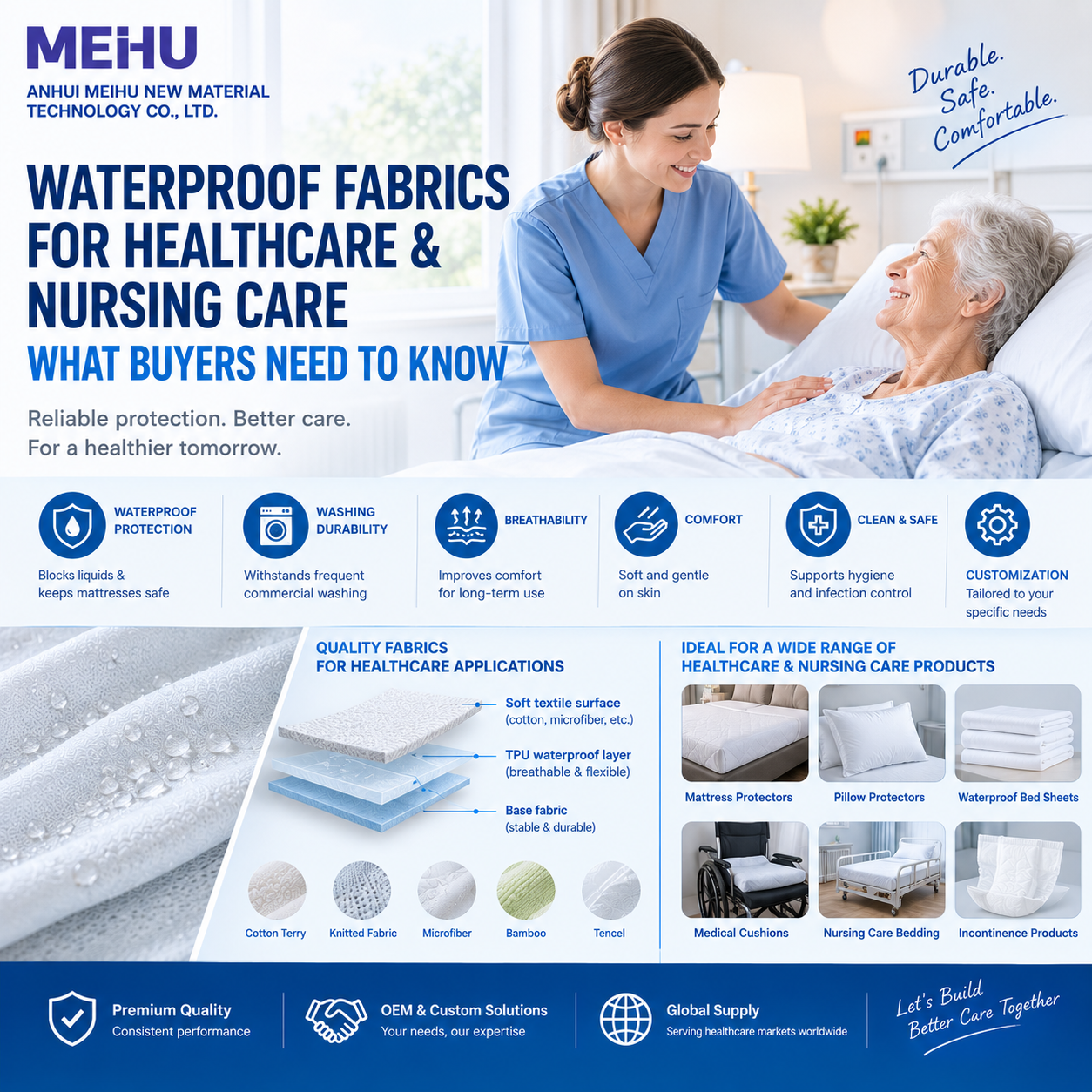
1 Waterproof Protection
The primary purpose of a waterproof healthcare fabric is to create a barrier against liquid.
Depending on the final application, waterproof fabrics may be used for:
- Mattress protectors
- Pillow protectors
- Incontinence products
- Nursing care bedding
- Medical cushions
- Protective covers
The required level of waterproof performance should be determined by the application and tested according to the relevant customer or market requirements.
2 Washing Durability Is Critical
Healthcare and nursing care products can be washed much more frequently than household bedding.
A mattress protector used in a care facility may need to withstand repeated cleaning throughout its service life.
Before selecting a fabric, buyers should provide information about:
- Washing temperature
- Washing frequency
- Detergent
- Drying conditions
- Expected service life
The supplier can then recommend a construction that is appropriate for the intended use.
3 Comfort Still Matters
Healthcare products are often used for long periods.
A waterproof cover shouldn’t unnecessarily compromise comfort.
Depending on the product, buyers may consider:
- Knitted fabric
- Cotton terry
- Microfiber
- Bamboo-based fabrics
- Other soft textile constructions
The surface fabric can influence:
- Hand feel
- Moisture absorption
- Stretch
- Warmth
- Overall comfort
The right combination depends on the application.
4 Breathability Can Improve User Comfort
For products that are in direct or prolonged contact with the user, breathability can be an important consideration.
A suitable TPU membrane can provide waterproof protection while allowing moisture vapor transmission in breathable constructions.
This can be particularly useful for:
- Mattress protectors
- Pillow protectors
- Nursing care products
- Long-term care bedding
For healthcare buyers, it is worth discussing both liquid protection and moisture vapor breathability when selecting the fabric.
5 Chemical and Cleaning Resistance
Healthcare environments can involve stronger cleaning procedures than normal household use.
The fabric construction therefore needs to be evaluated against the customer’s actual cleaning process.
Instead of simply asking:
“Is this fabric washable?”
a more useful question is:
“Can this exact fabric construction withstand our washing and cleaning conditions?”
Testing the finished material under the intended conditions is the best way to evaluate suitability.
6 TPU Lamination for Healthcare Products
TPU laminated fabric combines a textile surface with a waterproof TPU layer.
A typical construction might look like:
This construction can be customized according to the application.
For example, a customer may request:
- •Lightweight construction
- •Higher waterproof performance
- •Specific GSM
- •Specific width
- •Custom color
- •Higher washing durability
This makes TPU laminated fabric suitable for a wide range of healthcare and nursing care products.
7 Product Design Matters as Much as the Fabric
The fabric is only one part of the final product.
For a mattress protector, for example, buyers should also consider:
A waterproof fabric can perform well, but poor product construction can still create leakage problems.
This is why fabric selection and finished-product design should be considered together.
8 Quality Consistency Is Essential
Healthcare buyers often purchase repeatedly.
Once a fabric has been approved, future production should maintain consistent specifications.
Important characteristics include:
- GSM
- Width
- Color
- Surface appearance
- TPU specification
- Lamination quality
- Waterproof performance
For large-volume programs, consistent production is particularly important because the fabric may be used across many finished products.
9 OEM Options for Healthcare Buyers
Healthcare distributors and nursing care suppliers may require customized products.
Possible OEM options include:
- Custom fabric construction
- Custom GSM
- Custom color
- Custom width
- Custom mattress protector sizes
- Private labeling
- Custom packaging
The development process can begin with a sample and specification discussion before moving to mass production.
This allows the customer to test the fabric in the actual application before committing to a large order.
What Should Healthcare Buyers Ask a Supplier?
Before purchasing waterproof fabric, we recommend confirming:
Material
- • What is the face fabric?
- • What is the membrane material?
- • What is the GSM?
- • What is the TPU thickness?
Performance
- • What waterproof testing is available?
- • Is breathability required?
- • What washing conditions has the fabric been evaluated for?
Production
- • What is the MOQ?
- • What is the lead time?
- • What widths are available?
- • Can the construction be customized?
Quality
- • How is production quality controlled?
- • Can samples be provided?
- • Are relevant test reports or certifications available?
Providing these details early can help the manufacturer recommend a more appropriate solution.
From Healthcare Fabric to Finished Product
The development process can be simple:
This approach helps ensure that the final material is selected according to real-world requirements rather than specifications alone.
Why Work With an Experienced Waterproof Fabric Manufacturer?
For healthcare and nursing care products, buyers need more than a waterproof membrane.
They need a supplier who understands how different textile surfaces, TPU specifications, lamination processes, product designs, and washing requirements work together.
At Meihu, we manufacture TPU laminated waterproof fabrics and finished waterproof textile products for:
We can support OEM customers from fabric development and sampling through production, quality control, packaging, and export shipment.
If you are developing a healthcare or nursing care product, send us your requirements.
We can help you evaluate the right waterproof fabric construction for your application.
Post time: Sep-09-2026