
Introduction
Waterproof fitted bed sheets are an important product category for bedding brands, wholesalers, hotel suppliers, and healthcare textile distributors. They combine the familiar design of a fitted sheet with a waterproof barrier to help protect mattresses from liquid penetration.
For B2B buyers, developing a reliable waterproof fitted sheet involves more than selecting a waterproof fabric. Material comfort, mattress dimensions, elastic construction, seam protection, and washing durability all influence the final product.
This guide explains the key considerations when sourcing waterproof fitted bed sheets from an OEM manufacturer.
1. Choose the Right Face Fabric
The face fabric directly affects the product’s softness, appearance, flexibility, and comfort.
Common options include:
Knitted polyester fabric
Knitted polyester is flexible and suitable for fitted bedding products. Its stretch helps the sheet fit around different mattress shapes, depending on the fabric construction and pattern design.
Microfiber fabric
Microfiber provides a smooth surface and soft hand feel. It is a popular option for bedding products where a clean appearance and comfortable surface are important.
Cotton terry fabric
Cotton terry offers a textured, absorbent surface. It may be suitable for products positioned around a more traditional bedding feel.
Customized textile surfaces
Other fabric constructions can be considered according to the target market, product positioning, and budget.
When comparing materials, buyers should evaluate the face fabric together with the TPU waterproof layer. A comfortable surface fabric alone does not determine the performance of the complete product.
2. Select the Appropriate TPU Waterproof Layer
A TPU (thermoplastic polyurethane) membrane is commonly used in waterproof bedding products.
It provides a liquid barrier while allowing manufacturers to develop flexible fabric constructions. The appropriate membrane specification depends on the intended application and the required balance between waterproof performance, flexibility, and comfort.
Important factors include:
TPU membrane thickness
Target waterproof performance
Fabric weight and overall thickness
Flexibility and hand feel
Breathability requirements
Washing conditions and expected service life
A thicker TPU membrane does not automatically mean a better product. Buyers should select the membrane according to the actual product requirements and verify performance through appropriate testing.
For bulk orders, suppliers should confirm the material specifications and provide samples for evaluation before production.
3. Confirm Mattress Size and Pocket Depth
Correct sizing is essential for a fitted bed sheet.
A sheet that is too small may be difficult to install or may come loose during use. A sheet that is too large may wrinkle or fail to provide a secure fit.
Before requesting a quotation, buyers should provide:
Mattress length and width
Mattress thickness or height
Required pocket depth
Elastic design and coverage
Finished product dimensions and tolerances
Pocket depth is particularly important when supplying different mattress models or markets.
For example, a standard mattress and a deep mattress may require different side-panel dimensions. Buyers should avoid relying on general size labels alone and provide actual measurements.
For customized projects, developing a size chart for each market can help reduce fitting problems and simplify repeat orders.
4. Consider Elastic Design and Overall Construction
Elastic construction helps the fitted sheet stay in position during normal use.
Depending on the product design, manufacturers may use elastic around the entire perimeter or in selected sections.
When developing the product, consider:
Elastic width and stretch
Elastic coverage
Corner construction
Side-panel height
Ease of installation and removal
Fit after repeated washing
The design should provide a balance between secure fitting and convenient use.
For OEM projects, it is important to evaluate the finished sample on a mattress with the intended dimensions, rather than checking the flat fabric alone.
5. Why Seam Sealing Matters
One important consideration when manufacturing waterproof fitted bed sheets is seam performance.
Many fitted sheets are made by cutting and sewing separate fabric panels. These sewing operations create needle holes, which may become potential leakage points depending on the material and construction.
Using waterproof fabric does not automatically make every seam waterproof.
For applications requiring improved seam water resistance, manufacturers can evaluate suitable seam-sealing methods.
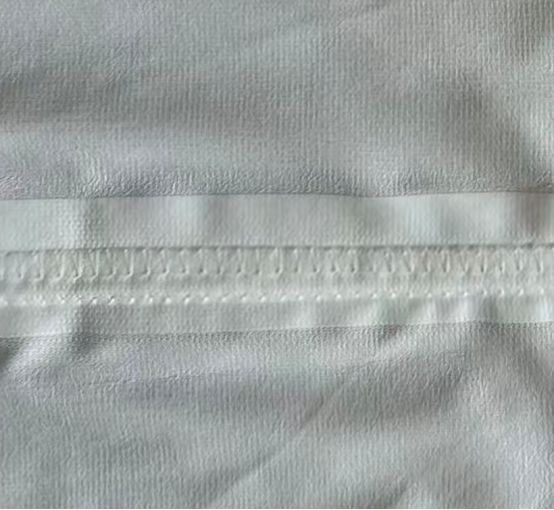
At Anhui Meihu New Material Technology Co., Ltd., our waterproof fitted-sheet production uses TPU seam-sealing tape technology to help improve water resistance at sewn panel joints.
This process is an important part of the finished-product construction, because the complete sheet needs to be evaluated rather than relying only on the waterproof performance of the raw fabric.
Buyers should discuss the seam construction and required waterproof performance with their supplier before sample approval. The finished product should be tested according to the agreed requirements.
6. Evaluate Washing Durability
Waterproof fitted bed sheets are often designed for repeated use and washing.
However, washing conditions can affect the face fabric, TPU membrane, elastic, stitching, and seam-sealing areas.
Before approving bulk production, consider checking:
1. Initial waterproof performance.
2. Fabric appearance and dimensional stability.
3. Elastic recovery after washing.
4. Seam and tape condition.
5. Waterproof performance after the agreed washing cycles.
The washing temperature, detergent, drying method, and number of cycles should reflect the intended care instructions.
For hotel and healthcare applications, buyers should provide the expected laundering conditions so the manufacturer can recommend a suitable construction.
7. OEM Customization Options
Private label brands may require different specifications depending on their target markets and product positioning.
Typical customization options include:
| Item | Customization Options |
| Face fabric | Knitted polyester, microfiber, cotton terry, and other materials |
| Waterproof layer | TPU membrane with specified thickness and performance |
| Mattress size | Single, double, queen, king, and customized dimensions |
| Pocket depth | Standard or deep-pocket designs |
| Elastic | Full-perimeter or selected-section elastic |
| Seam construction | Sewing and suitable TPU seam-sealing solutions |
| Color | Standard or customized colors |
| Labeling | Brand labels and care labels |
| Packaging | Individual bags, inserts, barcodes, and export cartons |
A clear technical specification helps the supplier evaluate feasibility and prepare an accurate quotation.
8. Questions to Ask a Waterproof Fitted Sheet Manufacturer
Before selecting an OEM supplier, buyers should confirm more than the unit price.
Useful questions include:
- · What face fabrics and TPU constructions are available?
- · Can you produce customized mattress sizes and pocket depths?
- · How are sewn seams handled in waterproof fitted sheets?
- · Can you provide samples for fit and waterproof testing?
- · How do you evaluate performance after washing?
- · What are the MOQ, sample lead time, and bulk production lead time?
- · Can you support private label packaging and labeling?
Comparing suppliers against the same specifications makes it easier to evaluate production capability, quality, and overall project cost.
Conclusion
Developing waterproof fitted bed sheets for a private label brand requires careful consideration of fabric selection, TPU membrane performance, mattress sizing, elastic construction, and seam protection.
For B2B buyers, the key is to evaluate the complete finished product rather than focusing only on the waterproof fabric.
Anhui Meihu New Material Technology Co., Ltd. manufactures waterproof bedding products and TPU laminated fabrics for B2B customers. We support OEM customization, material selection, and product development according to different project requirements.
Contact our team to discuss your waterproof fitted bed sheet project, customized specifications, and sampling requirements.
Email: trade@anhuimeihu.com
Website: www.meihumaterial.com
Post time: Nov-05-2026