
Introduction
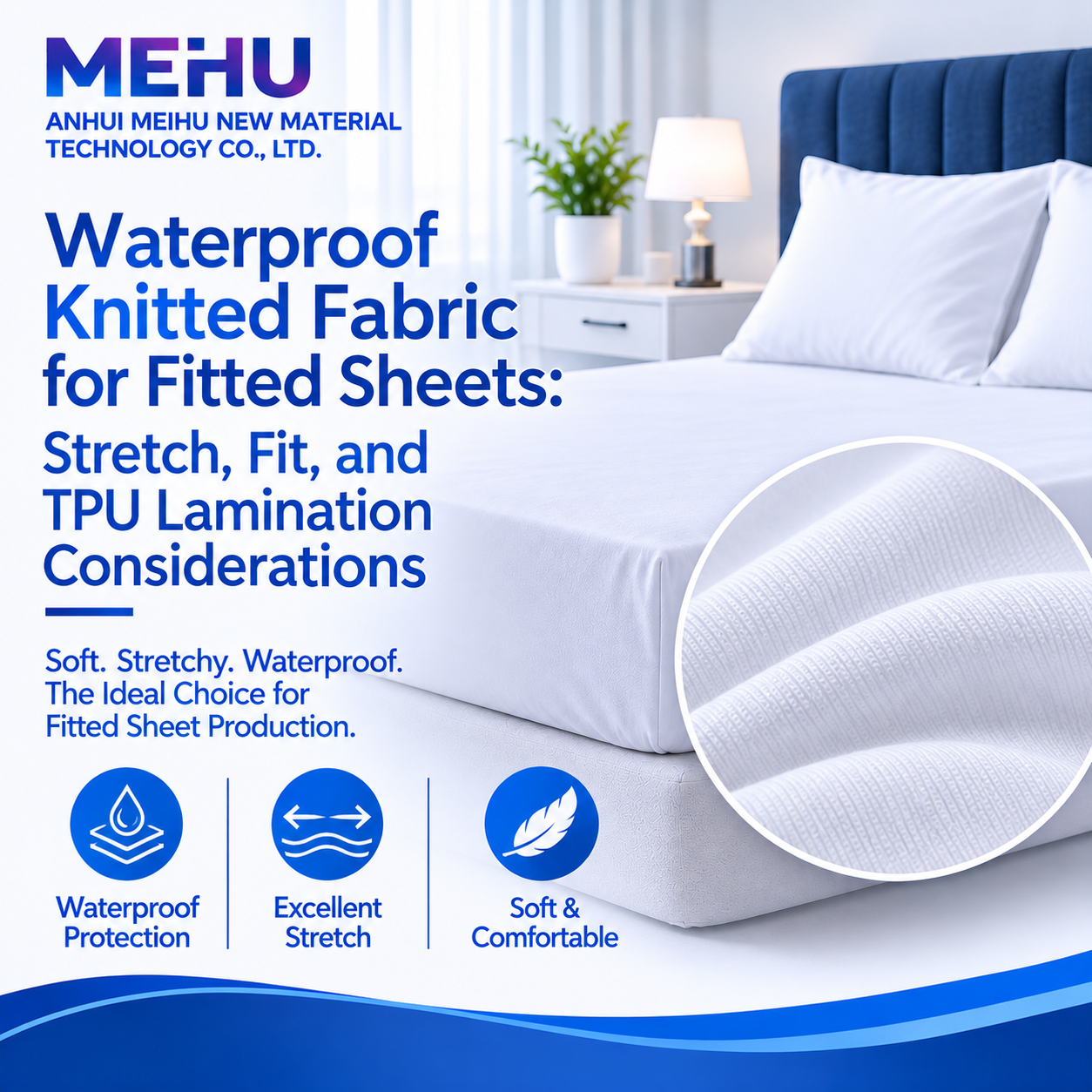
Waterproof knitted fabric is an important material option for manufacturers of fitted sheets, mattress protectors, and other waterproof bedding products.
Unlike conventional woven fabrics, knitted fabrics are formed through interconnected loops. Depending on the yarn and knitting construction, they can offer flexibility and stretch, helping finished bedding products fit around mattress corners and edges.
When a waterproof TPU membrane is added, the fabric can combine a textile surface with a liquid barrier.
For B2B buyers, however, selecting the right waterproof knitted fabric involves more than checking whether the material is waterproof. Fabric stretch, recovery, GSM, usable width, lamination quality, and finished-product construction all need to be considered.
This guide explains the key factors for sourcing waterproof knitted fabric for fitted sheet production.
1. Why Choose Knitted Fabric for Fitted Sheets?
Fitted sheets need to cover the mattress surface and extend around its sides. Their construction must accommodate mattress dimensions while remaining in position during normal use.
Knitted fabrics can be suitable for this application because of their flexible structure.
Potential advantages include:
Flexibility: The fabric can adapt to different mattress contours, depending on its construction.
Stretch: Suitable knitted structures can help improve fitting around mattress corners.
Soft hand feel: Different yarns and finishing processes can provide a comfortable surface.
Design flexibility: Knitted fabrics can be developed in different weights, textures, and constructions.
Not every knitted fabric has the same stretch or recovery. Buyers should evaluate the actual sample rather than assume that all knitted materials behave in the same way.
For fitted sheet projects, both stretch and recovery are important. A fabric that stretches easily but does not recover adequately may become loose or distorted during use.
2. Understand the Role of TPU Lamination
TPU stands for thermoplastic polyurethane. In waterproof bedding applications, a TPU membrane can be bonded to a textile surface to create a composite fabric.
The knitted face fabric provides the textile surface, while the TPU membrane serves as the liquid barrier.
When developing waterproof knitted fabric, buyers should pay attention to:
Face fabric composition and knitting construction
Fabric weight (GSM)
TPU membrane thickness
Lamination and bonding quality
Target waterproof performance
Flexibility and overall hand feel
Washing requirements
The membrane should be selected according to the final product’s intended use.
A thicker TPU membrane does not automatically mean better performance. The complete fabric construction should be evaluated for waterproof resistance, flexibility, comfort, and durability.
If breathability is important, buyers should specify the required water vapor transmission or other relevant test method. A general description of a fabric as breathable should be supported by appropriate test data.
3. Check Fabric GSM and Usable Width
GSM means grams per square meter. It indicates the weight of the fabric and is an important specification when comparing material options.
For waterproof knitted fabric, the total GSM may be influenced by the face fabric, TPU membrane, and lamination construction.
Fabric weight can affect:
Material consumption
Surface feel and thickness
Flexibility
Finished product weight
Purchasing and manufacturing costs
Usable width is equally important for fitted sheet manufacturers.
The available fabric width affects cutting layouts, panel dimensions, material utilization, and production efficiency.
Before requesting a quotation, buyers should confirm both the total fabric weight and usable width. It is also helpful to clarify whether the stated GSM refers to the textile face fabric alone or the complete TPU laminated fabric.
4. Stretch and Recovery: Two Important Factors
For fitted sheet production, stretch alone is not enough.
A suitable fabric should provide an appropriate balance between stretch and recovery.
Stretch
Stretch allows the material to extend when the fitted sheet is installed around a mattress. The required amount depends on the mattress dimensions, fitted sheet pattern, and elastic design.
Recovery
Recovery describes the fabric’s ability to return toward its original dimensions after stretching.
Poor recovery may result in excessive looseness or changes in fit after repeated use.
When evaluating samples, buyers should check:
1.Stretch in the lengthwise direction.
2.Stretch in the widthwise direction.
3.Recovery after repeated stretching.
4.Dimensional changes after washing.
5.Whether the TPU laminated construction affects the original fabric flexibility.
The finished product should also be tested on a mattress with the intended dimensions and thickness.
5. Why Lamination Quality Matters
A waterproof knitted fabric is a multi-layer construction. Its performance depends on the quality of both the textile and the TPU membrane bonding.
Poor lamination may cause bubbles, wrinkles, peeling, or separation between layers.
These defects can affect appearance and may compromise the intended waterproof performance.
During sample evaluation, buyers should inspect:
Surface uniformity
Visible bubbles or wrinkles
Delamination or peeling
Flexibility after repeated bending
Changes after washing
Waterproof performance before and after the agreed care procedure
A supplier should be able to explain the fabric construction and provide relevant performance information for the selected material.
6. Fitted Sheet Construction: Cut Panels, Sewing, and Seam Sealing
Selecting waterproof knitted fabric is only one part of fitted sheet manufacturing.
Many fitted sheets are produced by cutting separate fabric panels and sewing them together to create the top surface and side sections.
The finished product may also include elastic around the perimeter or selected sections to help hold the sheet in position.
However, sewing through waterproof fabric can create needle holes. Even when the original TPU laminated fabric provides the required waterproof performance, the sewn joints may become potential leakage points.
This is why seam construction deserves special attention.
Meihu’s TPU Seam-Sealing Tape Technology
At Anhui Meihu New Material Technology Co., Ltd., our waterproof fitted sheet production uses TPU seam-sealing tape technology to help improve water resistance at sewn panel joints.
This additional process addresses an important challenge in waterproof fitted sheet manufacturing: the seams need to be considered alongside the waterproof fabric itself.
For B2B buyers, it is worth asking suppliers:
How are sewn panel joints treated?
Is a suitable seam-sealing process available?
Can the finished product be tested for leakage?
Does the seam construction remain stable after the intended washing procedure?
The complete fitted sheet should be evaluated rather than assuming that waterproof raw material automatically makes every stitched area waterproof.
7. How to Evaluate Waterproof Knitted Fabric Samples
Before approving a bulk order, buyers should assess both the fabric and its performance in the intended finished product.
A practical sample evaluation process includes:
Step 1: Check the textile surface
Evaluate softness, appearance, texture, and fabric consistency.
Step 2: Confirm the specifications
Check fiber composition, GSM, usable width, and TPU membrane requirements.
Step 3: Evaluate stretch and recovery
Stretch the sample in both directions and assess whether it recovers appropriately.
Step 4: Inspect the lamination
Look for bubbles, uneven surfaces, or visible separation between the textile and membrane.
Step 5: Test waterproof performance
Use the agreed test method and acceptance criteria.
Step 6: Evaluate washing durability
Where repeated washing is expected, inspect the material and recheck relevant performance after the agreed washing procedure.
Step 7: Test the finished fitted sheet
Check mattress fit, elastic construction, sewn joints, and seam-sealing performance.
Keeping an approved reference sample and written specifications can help maintain consistency during mass production.
8. What Should B2B Buyers Provide When Requesting a Quotation?
To help manufacturers recommend a suitable waterproof knitted fabric, buyers should prepare a clear product specification.
Specification Information to Confirm
Application Fitted sheet, mattress protector, or other bedding product
Face fabric Fiber composition and knitted construction
GSM Face fabric weight or total laminated fabric weight
Usable width Required width for cutting and production
TPU membrane Required thickness and construction
Stretch Required stretch and recovery characteristics
Waterproof performance Target level and test method
Washing Expected care conditions
Seam construction Sewing and seam-sealing requirements
Order quantity Sample quantity and estimated bulk quantity
Providing these details helps suppliers evaluate the project more accurately and reduces unnecessary sampling.
Conclusion
Waterproof knitted fabric can be a suitable material choice for fitted sheets because it can combine a flexible textile structure with a TPU waterproof membrane.
However, successful product development requires attention to more than the raw material. Stretch, recovery, fabric weight, width, lamination quality, sewing, and seam sealing all contribute to the performance of the finished product.
At Anhui Meihu New Material Technology Co., Ltd., we manufacture TPU laminated waterproof fabrics and waterproof bedding products for B2B customers. Our fitted sheet production also uses TPU seam-sealing tape technology to help improve water resistance at sewn panel joints.
Contact our team to discuss waterproof knitted fabric, fitted sheet OEM development, and customized material requirements.
Email: trade@anhuimeihu.com
Website: www.meihumaterial.com
Post time: Nov-18-2026