
If you’ve been researching materials for high-end mattress protectors, you’ve likely come across the term “air layer fabric.” It appears with increasing frequency in premium bedding product descriptions, and for good reason. Among the available TPU laminated fabric options for mattress protectors, air layer fabric offers a specific combination of performance characteristics that other constructions simply cannot replicate.
This guide explains what air layer fabric is, how it works, why it has become the preferred choice for premium mattress protector manufacturers, and what to consider when sourcing it.
What Is Air Layer Fabric?
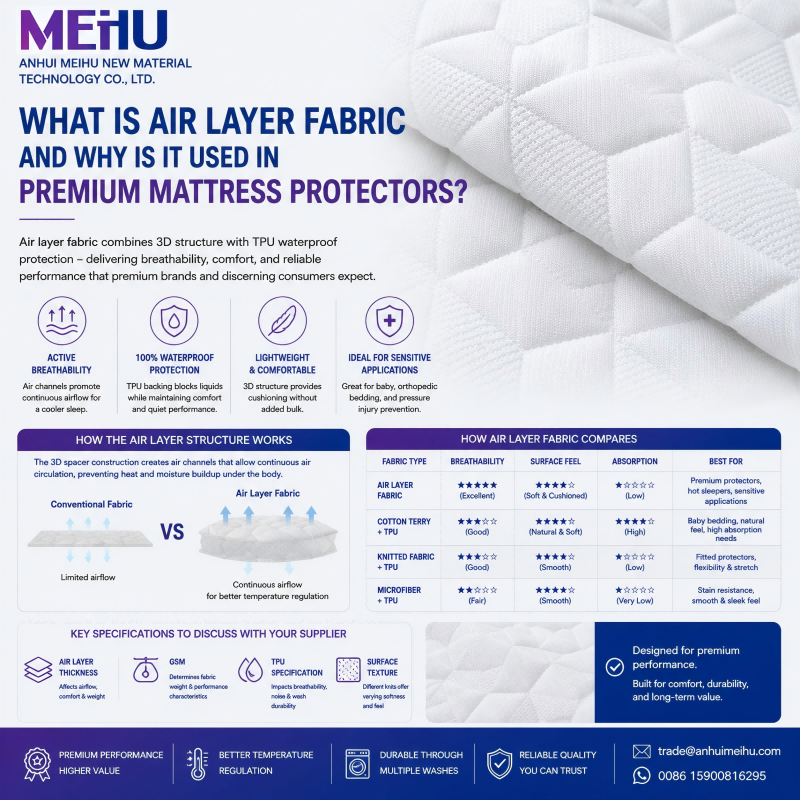
Air layer fabric is a three-dimensional knitted textile constructed with two outer surface layers connected by a network of internal spacer yarns. Unlike conventional flat-knit or woven fabrics, the internal yarn structure creates a physical gap between the surfaces — an integrated air channel that runs throughout the fabric.
This construction is sometimes referred to as spacer fabric or 3D knit fabric in technical contexts, though “air layer” is the most commonly used commercial term in the bedding industry.
When bonded with a TPU waterproof membrane on the reverse side, air layer fabric becomes a composite material that combines structural breathability with reliable liquid barrier performance — a combination that standard flat fabrics cannot achieve at the same level.
How Does the Air Layer Structure Work?
The performance advantage of air layer fabric comes directly from its three-dimensional construction.
In a conventional knitted or woven fabric, the structure is essentially flat. Air movement through the fabric depends entirely on the porosity of the fibers and weave — which is limited, particularly once a TPU membrane is applied to the reverse side.
In an air layer fabric, the internal spacer construction creates a continuous network of air channels that run parallel to the fabric surface. These channels allow air to circulate laterally through the fabric even when body weight is applied, preventing the heat and moisture accumulation that occurs with flat fabric constructions under sleeping conditions.
The result is a fabric that actively promotes airflow rather than simply allowing it — a meaningful difference for sleepers who experience heat buildup or night sweats, and a strong product differentiation point for mattress protector brands competing in the premium segment.
Why Do Premium Mattress Protector Brands Choose Air Layer Fabric?
Temperature Regulation as a Marketing Advantage
Consumer awareness of sleep temperature has increased significantly in recent years. Mattress protector brands that can credibly claim cooling or temperature-regulating performance command higher retail price points and attract more engaged buyers. Air layer fabric provides a genuine, structurally based breathability advantage that supports these claims — unlike marketing language applied to standard fabrics.
Comfort Without Compromise
Most waterproof mattress protectors involve a trade-off: the waterproof barrier reduces breathability. Air layer fabric minimizes this trade-off more effectively than other constructions, making it possible to offer both reliable waterproof protection and genuine comfort. This positions the finished product differently from standard terry or microfiber protectors.
Lightweight Construction
Despite its three-dimensional structure, air layer fabric is relatively lightweight, which makes finished products easier to handle, wash, and store. For brands selling into markets where practicality matters alongside performance, this is a useful secondary benefit.
Suitability for Sensitive Applications
The breathable, non-compressive structure makes air layer TPU fabric particularly suitable for baby mattress covers, orthopedic bedding, and applications where prolonged skin contact or pressure injury prevention is a concern. These segments tend to attract buyers with higher quality expectations and stronger purchasing intent.
How Does Air Layer Fabric Compare to Other Waterproof Fabric Options?
Understanding where air layer fabric sits relative to other TPU laminated options helps clarify which applications it is genuinely best suited for:
Key Specifications to Discuss with Your Supplier
When sourcing air layer fabric for mattress protector production, the following specifications are particularly important:
Air Layer Thickness
The depth of the internal spacer structure affects both breathability and fabric weight. Thicker air layers offer more pronounced airflow benefits but add weight and bulk to the finished product. Discuss the right balance based on your product application.
GSM
Air layer fabrics are typically heavier than flat-knit alternatives due to the three-dimensional construction. Confirm the available GSM range and how different weights affect hand feel, breathability performance, and finished product characteristics.
TPU Specification
The thickness and formulation of the TPU membrane affects breathability, noise performance, and wash durability. Request samples with different TPU specifications to evaluate the performance trade-offs before finalizing your specification.
Surface Texture
The outer surface of air layer fabric can vary in texture and softness depending on the yarn type and knit specification used. Request swatches to evaluate surface feel, as product photos rarely convey this accurately.
Air layer fabric represents one of the more technically differentiated options in the waterproof fabric category — and for brands building premium mattress protector products, that differentiation translates directly into stronger market positioning and higher achievable price points.
If you are developing a waterproof mattress protector with breathability as a core performance feature, air layer fabric is worth evaluating alongside your current material specifications. Contact us to request samples and discuss customization options.
Post time: Jun-12-2026