
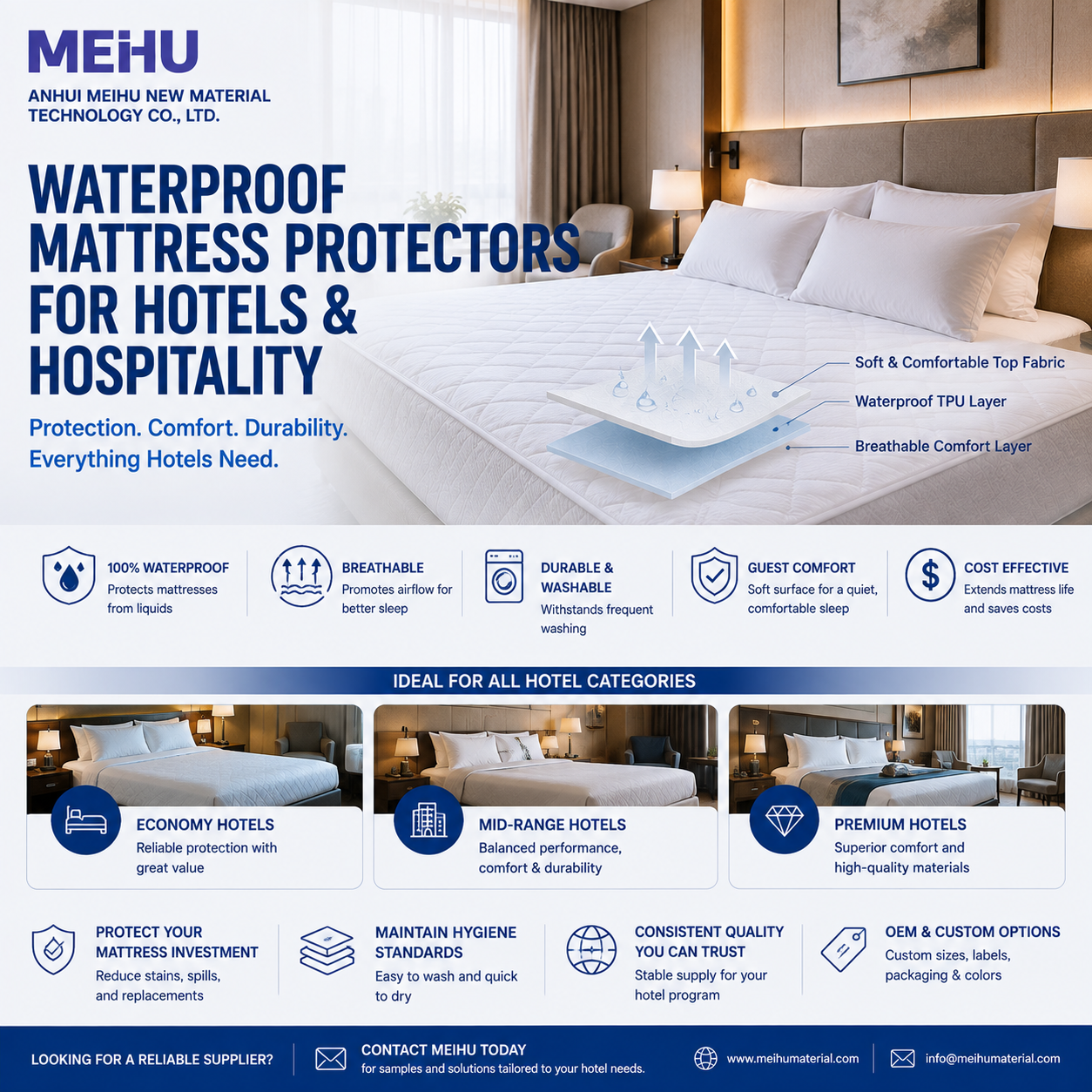
Hotels replace and wash bedding much more frequently than most households.
That creates a different set of requirements for mattress protectors.
A waterproof mattress protector used in a hotel needs to do more than protect a mattress from occasional spills.
It may need to withstand:
At the same time, guests still expect the bed to feel comfortable.
1
Waterproof Protection Comes First
The primary function of a mattress protector is protecting the mattress.
Hotels need reliable protection against:
- Water
- Drinks
- Sweat
- Other liquids
A waterproof TPU layer provides a barrier between the surface fabric and mattress.
For hotel applications, consistent waterproof performance is particularly important because one damaged mattress can be significantly more expensive to replace than a mattress protector.
2
Comfort Still Matters
Guests should not feel like they are sleeping on a waterproof sheet.
This is where the surface fabric becomes important.
A mattress protector can use different textile surfaces depending on the target product.
For example:
Soft and flexible, suitable for fitted mattress protectors.
Provides a familiar textile feel and moisture absorption.
Smooth, lightweight, and practical.
The surface fabric should be selected based on the hotel’s positioning and guest experience.
3
Breathability Is Important
Hotels need protection without sacrificing sleeping comfort.
A completely waterproof construction may prevent liquid penetration, but the overall fabric construction should also be considered for moisture vapor breathability.
This is particularly relevant for hotels in:
- Warm climates
- Humid regions
- Tropical markets
For these markets, a lightweight and breathable waterproof construction can be more attractive than a heavy, thick product.
4
Durability Under Commercial Washing
This is one of the biggest differences between home and hotel applications.
A hotel mattress protector may be washed repeatedly during its service life.
Therefore, buyers should ask suppliers about:
A fabric that performs well after several household washes may not necessarily provide the same lifespan under commercial laundry conditions.
5
Choose the Right Construction for the Hotel
Not every hotel needs the same mattress protector.
Economy Hotels
Cost efficiency may be the priority.
A practical microfiber or polyester construction with reliable waterproof protection may be suitable.
Mid-Range Hotels
The balance between comfort, durability, and price becomes more important.
Knitted or cotton terry fabrics may be attractive options.
Premium Hotels
Guest comfort and perceived quality become increasingly important.
Premium textile surfaces such as cotton, bamboo, or Tencel-based constructions may be considered depending on the target product and budget.
6
Fitted Design vs. Flat Design
The mattress protector’s construction also affects the fabric requirements.
A fitted mattress protector needs enough flexibility and suitable dimensions to cover the mattress securely.
A common design uses:
- Waterproof top
- Elasticized skirt
- Deep-pocket construction
For buyers, it is therefore important to confirm:
- Mattress size
- Mattress thickness
- Pocket depth
- Elastic requirements
- Fabric width
The correct fabric specification should be considered together with the final product design.
7
Total Cost Is More Important Than Fabric Price
Hotels purchase in volume, so price matters.
But the cheapest fabric isn’t always the most economical choice.
Consider Formula
+
Manufacturing cost
+
Washing and maintenance
+
Replacement frequency
+
Product lifespan
=
Total cost
A more durable mattress protector may have a higher initial price but reduce replacement frequency.
For hospitality buyers, this total-cost perspective can be more useful than comparing fabric prices alone.
8
Consistency Matters for Hotel Programs
Hotels often purchase the same product repeatedly.
Once a product has been approved, future production should remain consistent.
Important characteristics include:
This is especially important for hotel groups or distributors supplying multiple properties.
A reliable manufacturer should be able to reproduce the approved specification over multiple orders.
9
OEM Customization Can Be Valuable
Hotels and hospitality suppliers may have specific requirements for:
- ✓ Brand labels
- ✓ Packaging
- ✓ Colors
- ✓ Mattress sizes
- ✓ Pocket depth
- ✓ Fabric construction
An OEM manufacturer can develop the product around these requirements.
Instead of purchasing a generic mattress protector, buyers can develop a product specifically for their market.
Hotel Mattress Protector Buyer Checklist
Before placing an order, consider the following:
| Requirement | Questions to Ask |
|---|---|
| Waterproofing | What level of protection is required? |
| Comfort | What surface fabric is most suitable? |
| Breathability | Is the product suitable for the target climate? |
| Washing | How frequently will it be washed? |
| Durability | How long should the product last? |
| Size | What mattress sizes are required? |
| What mattress thickness must it accommodate? | |
| MOQ | What quantity is required? |
| OEM | Are custom labels, colors, or packaging needed? |
| Logistics | How many pieces can fit in a container? |
A Practical Approach to Hotel Mattress Protector Sourcing
The best sourcing process starts with the finished product.
First determine:
This approach helps buyers avoid choosing a fabric based solely on price.
Final Thoughts
A good hotel mattress protector should be almost invisible to the guest.
It should provide reliable protection without compromising comfort.
For hotel and hospitality applications, the most important factors are usually:
Comfort
Breathability
Washing Durability
Consistent Quality
Cost Efficiency
At Meihu, we manufacture TPU laminated waterproof fabrics and finished waterproof bedding products for different applications, including hospitality, healthcare, nursing care, and home bedding.
If you are developing a hotel mattress protector or looking for a supplier for an existing program, we can help you evaluate the fabric construction and develop samples according to your requirements.
Contact Meihu to discuss your hospitality bedding project.
Post time: Sep-01-2026