
Choosing a waterproof fabric supplier is a significant sourcing decision. The right supplier delivers consistent quality, meets your specifications, and supports your production timeline reliably. The wrong one costs you time, money, and in some cases, market reputation.
The difference often comes down to what questions you ask — and when. This guide outlines the key questions every B2B buyer should raise with a potential waterproof fabric supplier before committing to an order.
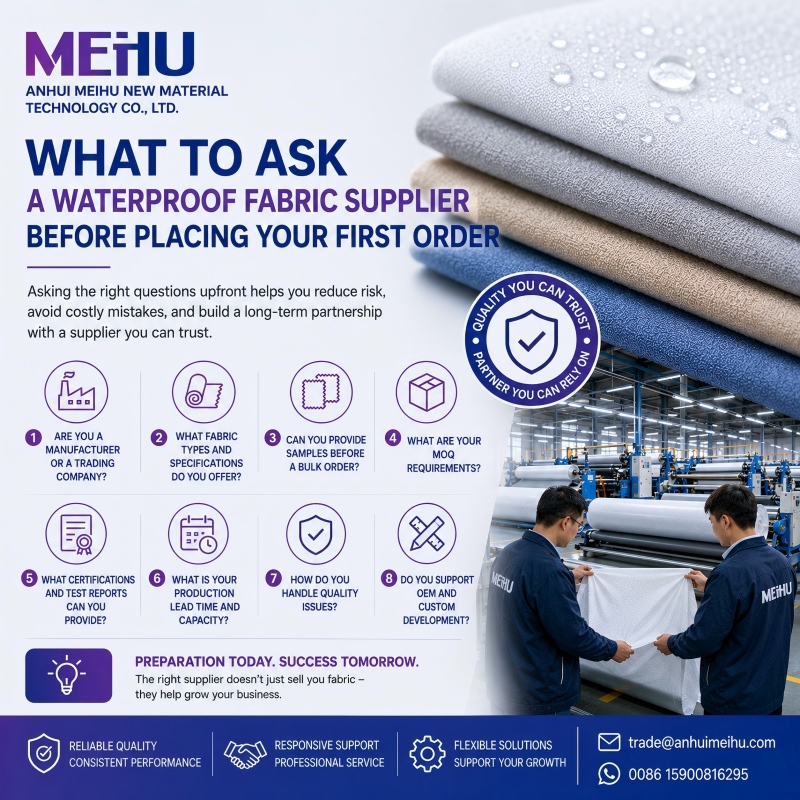
1. Are You a Manufacturer or a Trading Company?
This is the first question to clarify. Manufacturers produce the fabric directly, which typically means better pricing, more control over customization, and faster resolution of quality issues. Trading companies source from third-party factories, adding a layer between you and production.
Neither is necessarily wrong for every buyer — trading companies can offer wider product variety and lower MOQ thresholds in some cases. But knowing which type of supplier you’re dealing with helps you set the right expectations for pricing, lead time, and technical support.
Ask directly, and if the supplier claims to be a manufacturer, ask for factory photos, production capacity data, or an invitation to visit.
2. What Fabric Types and Specifications Do You Offer?
A capable waterproof fabric supplier should offer multiple base fabric options — such as cotton terry, knitted, microfiber, coral fleece, air layer, and quilted — with TPU lamination available across the range.
Ask specifically about GSM range, available widths, TPU thickness options, and color availability. A supplier who can only offer a narrow range of fixed specifications will limit your product development flexibility over time.
3. Can You Provide Samples Before a Bulk Order?
Any reputable fabric supplier should offer samples. The more important question is whether they can provide samples that accurately represent bulk production — not just showroom-quality pieces that don’t reflect what you’ll actually receive at scale.
Ask whether the sample will be produced on the same equipment and with the same materials as a bulk order. Ask about sample lead time and whether there are sample fees. Understanding this process upfront prevents misaligned expectations later.
4. What Are Your MOQ Requirements?
Minimum order quantities vary significantly between suppliers and fabric types. Clarify MOQ per color, per fabric type, and whether there are different thresholds for standard versus custom specifications.
If your initial order volume is below the standard MOQ, ask whether trial order arrangements are possible. Some suppliers offer flexibility for first orders from established brands or buyers with clear long-term potential.
5. What Certifications and Test Reports Can You Provide?
For buyers selling into regulated markets — particularly the EU, North America, and Australia — certification documentation is not optional. Ask specifically about OEKO-TEX Standard 100, SGS or Bureau Veritas test reports, and any relevant chemical compliance documentation such as REACH.
Request copies of current certificates rather than descriptions of what the supplier “can” provide. If certification is important to your procurement process, verify documents before placing an order, not after.
6. What Is Your Production Lead Time and Capacity?
Understanding lead time is critical for planning your production and inventory cycles. Ask for typical lead time from order confirmation to ready-to-ship, broken down by standard stock availability and custom production timelines.
Also ask about monthly production capacity. A supplier whose capacity is already heavily committed may not be able to scale with you as your order volume grows — which creates supply risk further down the line.
7. How Do You Handle Quality Issues?
No production run is perfect. What matters is how a supplier responds when problems occur. Ask directly: what is their process for handling fabric defects, specification deviations, or short shipments?
A supplier with a clear, documented quality control process and a straightforward approach to resolving issues is significantly lower risk than one who becomes evasive when the topic comes up. This conversation also signals to the supplier that you are a quality-conscious buyer, which tends to result in more careful handling of your orders.
8. Do You Support OEM and Custom Development?
If you are building a brand or developing proprietary products, confirm whether the supplier supports OEM production including custom GSM, width, color, and — if relevant — private label packaging.
Ask about the custom development process: what information do you need to provide, what is the timeline, and what is the minimum commitment for custom specifications? Understanding this upfront helps you assess whether the supplier is genuinely set up to be a long-term development partner.
Asking these questions before your first order significantly reduces sourcing risk and helps you identify suppliers who are genuinely capable of supporting your business over the long term. If you are currently evaluating waterproof fabric suppliers and would like to discuss any of these points with our team, we welcome the conversation.
If you are also considering waterproof finished bedding products rather than fabric only, we can walk you through both options and help you identify the most efficient sourcing approach for your product line.
trade@anhuimeihu.com | WhatsApp: 0086 15900816295
Post time: Jun-08-2026