
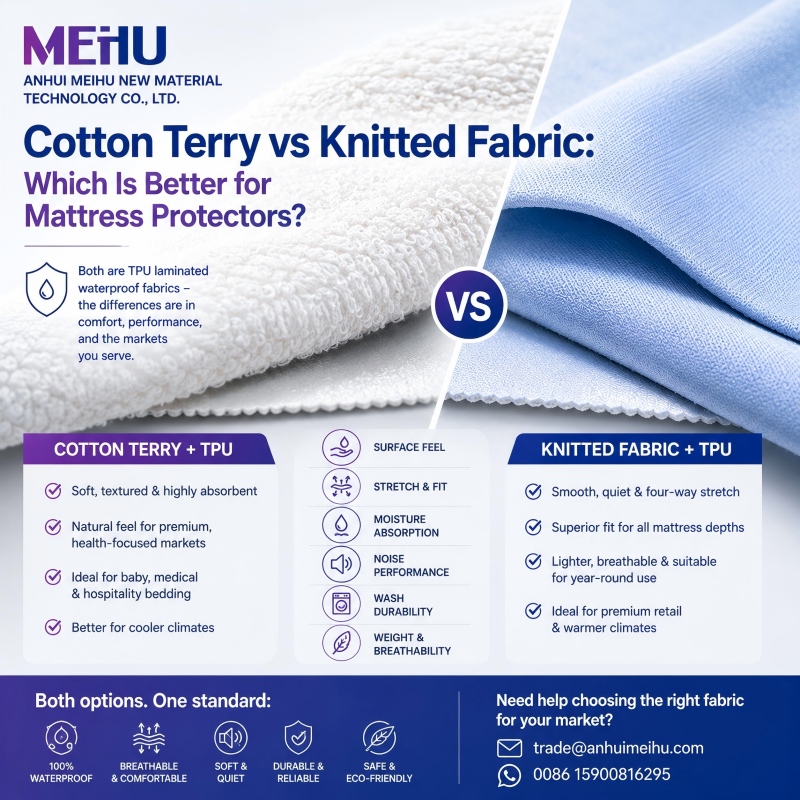
When sourcing fabric for waterproof mattress protectors, two options consistently dominate the conversation: cotton terry and knitted fabric, both laminated with a TPU waterproof membrane. On the surface, both deliver reliable liquid protection — but the differences in how they feel, perform, and suit different market segments are significant enough to affect your product’s success in the market.
This guide compares both materials across the key dimensions that matter most to mattress protector manufacturers and brand buyers.
What Is Cotton Terry Fabric with TPU Lamination?
Cotton terry TPU laminated fabric features a looped cotton or cotton-blend surface bonded to a thin TPU waterproof membrane. The terry loops create a textured surface that absorbs surface moisture quickly — a familiar, comfortable feel that most consumers associate with quality bedding.
The natural or semi-natural composition of cotton terry makes it a popular choice for brands positioning their products in the premium, natural, or health-focused segment. It is also widely specified for baby bedding, medical care textiles, and hospitality products where skin contact comfort is a priority.
What Is Knitted Fabric with TPU Lamination?
Knitted TPU laminated fabric uses a circular-knit polyester construction bonded to a TPU membrane. The key characteristic that sets it apart is four-way stretch — the fabric moves naturally in all directions, conforming to mattress contours and body movement without bunching or lifting at the corners.
The smooth, close-knit surface and low-noise TPU backing make knitted fabric the preferred choice for brands competing in the premium consumer market, where noise-free performance and a refined surface feel are expected.
Performance Comparison
Surface feel — Cotton terry offers a soft, textured, absorbent surface that many consumers perceive as more natural and comfortable. Knitted fabric provides a smoother, more refined feel with a slight sheen that communicates quality in a different way. Neither is objectively superior — the right choice depends on your target consumer and brand positioning.
Stretch and fit — Knitted fabric offers significantly better stretch and recovery than cotton terry. For fitted mattress protectors that need to stay securely in place across a range of mattress depths, knitted fabric provides a more reliable fit. Cotton terry constructions typically use elastic edging to compensate for limited stretch.
Moisture absorption — The looped surface of cotton terry absorbs surface perspiration more quickly than the flat surface of knitted fabric. For consumers who sleep hot or in humid climates, this can be a meaningful performance difference.
Noise performance — Both materials use TPU backing, which is inherently quieter than PVC. However, knitted constructions with finer TPU lamination tend to produce less noise during movement than heavier terry constructions. For consumer retail products, this is worth testing with samples before committing to production.
Wash durability — Both materials maintain waterproof performance after repeated machine washing when laundered correctly. Cotton terry may experience some shrinkage over time if washed at high temperatures, which can affect fit. Knitted fabric generally has better dimensional stability. Confirm specific wash performance with your supplier before specifying for institutional applications.
Weight and breathability — Cotton terry tends to be heavier and warmer, which suits cooler climates and winter bedding markets. Knitted fabric is typically lighter and more breathable, making it a better fit for year-round use or warmer market regions.
Application Recommendations
Choose Cotton Terry if:
- · Your brand targets natural, organic, or health-conscious positioning
- · Your primary markets are baby bedding, medical care, or hospitality
- · Your consumers prioritize surface softness and moisture absorption over stretch performance
- · You are developing products for cooler climate markets
Choose Knitted Fabric if:
- · Your brand competes in the premium consumer or retail segment
- · You need a fitted protector that stays in place across varied mattress depths
- · Noise-free performance is a key marketing claim
- · You are developing products for year-round use or warmer climates
Both are suitable for:
- · OEM and private label production
- · Hotel and hospitality supply
- · Healthcare and institutional bedding
- · Custom GSM, width, and color specifications
If you are developing a waterproof mattress protector line and are unsure which fabric construction best suits your product requirements and target market, contact us to request samples of both materials for side-by-side evaluation.
trade@anhuimeihu.com | WhatsApp: 0086 15900816295
Post time: Jun-08-2026