
How Much Does Waterproof Fabric Really Cost?
When sourcing waterproof fabric, many buyers start with one number:
Price per meter.
But for mattress protector manufacturers, the lowest price per meter does not always mean the lowest production cost.
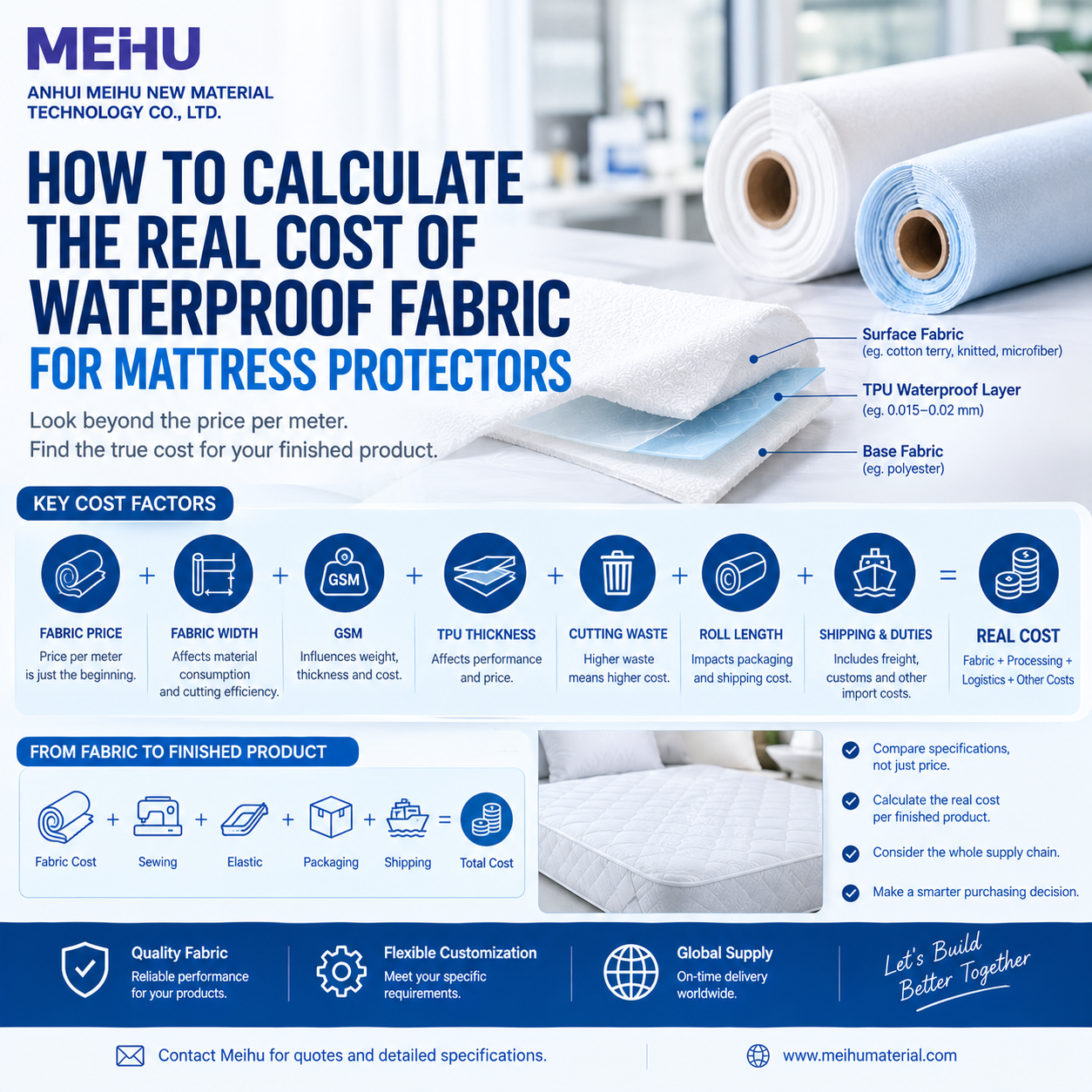
The actual cost depends on several factors, including fabric width, GSM, TPU specification, cutting efficiency, waste, and shipping.
For B2B buyers, understanding these factors can make supplier comparisons much more accurate.
1. Price Per Meter Is Only the Starting Point
Imagine two suppliers quote:
Supplier A: $1.80/m
Supplier B: $1.90/m
At first glance, Supplier A appears cheaper.
But what if Supplier A offers a narrower fabric?
If more fabric is required to manufacture the same mattress protector, the difference in price per meter may disappear.
This is why buyers should compare cost per finished product, rather than only cost per meter.
2. Fabric Width Can Affect Material Consumption
Width is especially important when producing mattress protectors.
A wider fabric may improve cutting efficiency and reduce unnecessary waste.
Before comparing quotations, confirm:
Finished fabric width
Usable width
Mattress protector dimensions
Cutting layout
Expected material consumption
A small difference in fabric utilization can become significant when producing thousands of pieces.
3. GSM Affects Both Price and Product Positioning
GSM refers to the weight of fabric per square meter.
A higher GSM generally means more material is used, but it doesn’t automatically mean a better product.
For example:
Lightweight mattress protector
may prioritize:
Lower weight
Softer hand feel
Flexibility
Breathability
Lower shipping cost
A heavier construction may be selected when the product requires a different level of durability or warmth.
The appropriate GSM should therefore be based on the finished product.
4. TPU Thickness Also Affects Cost
The waterproof membrane is another important component.
For example, Meihu can develop waterproof fabrics using different TPU specifications depending on the application.
A thinner TPU layer may help create a lighter construction.
A different TPU specification may be required for products with more demanding waterproof or durability requirements.
The goal should be to select the appropriate TPU specification, rather than simply choosing the thickest available film.
5. Don’t Forget Cutting Waste
Fabric waste is part of the real cost.
The actual calculation is closer to:
Fabric Cost = Fabric Price × Actual Consumption
rather than simply:
Fabric Price × Mattress Size
Actual consumption can be affected by:
Mattress dimensions
Pocket depth
Fabric width
Cutting layout
Elasticized skirt
Sewing allowance
Cutting waste
For large production runs, improving cutting efficiency can make a noticeable difference.
6. Roll Length Matters Too
The quotation should also clarify how the fabric is packed.
For example:
Average roll length
Maximum roll length
Minimum roll length
Roll weight
Packaging method
Consistent roll lengths can make warehouse management and production planning easier.
For large B2B orders, these details can also affect loading efficiency.
7. Shipping Cost Should Be Included
Waterproof fabric is usually shipped internationally in rolls.
Therefore, buyers should consider:
Fabric cost + packaging + freight + customs-related costs
when calculating the landed cost.
A fabric with a slightly higher unit price may have different logistics efficiency because of:
GSM
Roll length
Roll diameter
Packaging
Container utilization
For container-volume orders, these factors deserve attention.
A Simple B2B Cost Calculation
A useful starting formula is:
Total Material Cost = Fabric Price × Actual Fabric Consumption
Then add:
Packaging + Shipping + Other Import Costs
to estimate the landed cost.
For finished mattress protectors, the calculation can go further:
Fabric
Elastic
Sewing
Packaging
Shipping
=
Estimated Finished Product Cost
This gives buyers a much clearer picture of the real economics.
What Should You Ask Your Waterproof Fabric Supplier?
Before comparing quotations, ask every supplier to provide the same information:
Fabric composition
GSM
Width
TPU thickness
Waterproof specification
Price per meter
Roll length
MOQ
Lead time
Packaging
Container loading quantity
Then compare the quotations using the same specifications.
This prevents a low quotation from looking attractive simply because the specifications are different.
Final Thoughts
For B2B waterproof fabric sourcing, the cheapest price per meter isn’t necessarily the cheapest solution.
A better approach is to compare:
Specification → Consumption → Waste → Finished Product Cost → Landed Cost
At Meihu, we can customize waterproof laminated fabrics according to different product requirements, including GSM, width, textile surface, TPU specification, color and other OEM requirements.
If you have a target product and annual volume, send us your specifications.
We can help you evaluate a suitable fabric construction and quotation.
Post time: Sep-18-2026