
How to Source Waterproof Fabric from China: A Step-by-Step Buyer’s Guide
China remains the world’s largest producer of waterproof composite fabrics, offering a combination of manufacturing scale, material variety, and competitive pricing that is difficult to match elsewhere. However, for buyers sourcing for the first time — or switching suppliers — the process can feel overwhelming. This guide walks you through each step, from identifying your requirements to placing your first bulk order.
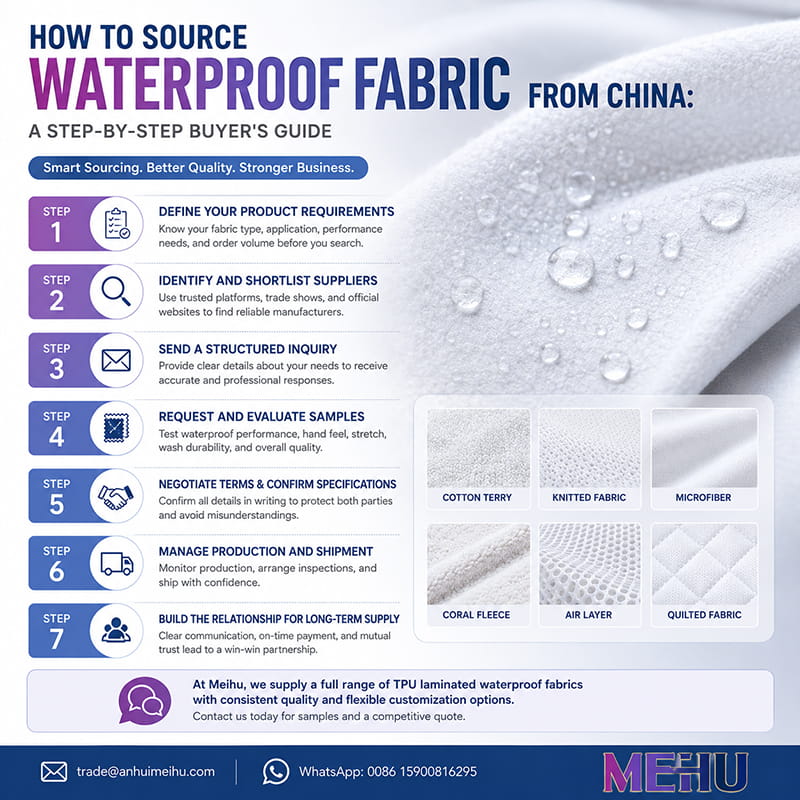
Step 1: Define Your Product Requirements Before You Search
Before reaching out to any supplier, you need a clear picture of what you’re looking for. Vague inquiries receive vague responses — and waste time on both sides.
At minimum, you should be able to specify the following before your first contact:
Fabric type — Are you looking for cotton terry, knitted stretch fabric, microfiber, coral fleece, air layer, or quilted fabric with TPU lamination? Each has different performance characteristics suited to different end products.
End application — What finished product will the fabric be used for? A waterproof mattress protector has different requirements than a pet mat or a hospital care pad.
Key performance needs — Waterproof rating, breathability, stretch, noise level, wash temperature tolerance.
Approximate order volume — Even a rough estimate helps suppliers assess whether they can serve your needs and quote accurately.
Having this information ready makes your inquiry stand out and signals to suppliers that you are a serious buyer.
Step 2: Identify and Shortlist Suppliers
There are several channels for finding waterproof fabric manufacturers in China:
Trade platforms — Alibaba, Made-in-China, and Global Sources list thousands of fabric suppliers. Use specific search terms such as “TPU laminated waterproof fabric manufacturer” rather than generic terms to filter out trading companies and find actual factories.
Trade shows — Canton Fair (Guangzhou), Intertextile Shanghai, and Heimtextil are the major events where Chinese fabric manufacturers exhibit. Meeting suppliers in person accelerates trust-building significantly.
Direct manufacturer websites — Suppliers with detailed, well-maintained websites and clear product specifications are generally more reliable than those with minimal online presence.
When shortlisting, look for suppliers who manufacture rather than trade, have clear product specifications and photos, respond promptly and professionally, and can provide certification documentation upon request.
Step 3: Send a Structured Inquiry
A well-structured inquiry gets a faster, more useful response. Include the following in your first message:
- · Your company name and country
- · The specific fabric type and application you need
- · Any known specifications (GSM range, width, color preference)
- · Your estimated order volume and frequency
- · Whether you need samples before committing to a bulk order
Avoid sending a one-line message such as “Please send me your price list.” This signals a low-commitment buyer and often results in a generic response.
Step 4: Request and Evaluate Samples
Never place a bulk order without physically evaluating samples. When requesting samples, be specific about what you want to test — waterproof performance, hand feel, stretch, wash durability, or color accuracy.
When samples arrive, evaluate the following:
Surface quality — Is the texture consistent? Are there any defects, loose fibers, or uneven lamination?
Waterproof performance — Pour water onto the fabric and observe. Does it bead off cleanly or slowly absorb? For critical applications, request laboratory test reports.
Hand feel and noise — Handle the fabric as your end customer would. Is it soft and quiet, or stiff and crinkly?
Wash test — Machine wash the sample according to the supplier’s recommended care instructions and re-evaluate waterproof performance and dimensional stability afterwards.
Document your findings across all shortlisted suppliers before making a decision.
Step 5: Negotiate Terms and Confirm Specifications
Once you have identified your preferred supplier, confirm the following in writing before placing an order:
- · Final fabric specifications (GSM, width, TPU thickness, color)
- · Unit price and total order value
- · MOQ and payment terms
- · Sample approval process
- · Production lead time and shipment schedule
- · Packaging requirements
- · Quality inspection arrangements
Do not rely on verbal agreements. A clear purchase order with agreed specifications protects both parties and reduces the risk of disputes.
Step 6: Manage Production and Shipment
For first-time orders, consider arranging a third-party quality inspection before shipment. Inspection companies such as SGS, Bureau Veritas, and Intertek offer pre-shipment inspection services that verify fabric quality, quantity, and packaging against your purchase order specifications.
Confirm your shipment terms (FOB, CIF, EXW) and arrange cargo insurance for valuable orders. Work with a freight forwarder experienced in textile shipments to manage customs documentation efficiently.
Step 7: Build the Relationship for Long-Term Supply
The most cost-effective sourcing strategy is not always finding the cheapest supplier — it is building a reliable long-term relationship with a manufacturer who understands your product requirements and maintains consistent quality across multiple orders.
Communicate clearly, pay on time, and provide constructive feedback on samples and production quality. Suppliers invest more attention and flexibility in buyers who treat them as partners rather than transaction counterparts.
At Meihu, we work with bedding manufacturers, brand owners, and importers across multiple markets to supply TPU laminated fabrics with consistent quality and flexible customization options. If you are currently evaluating waterproof fabric suppliers, we welcome the opportunity to send samples and discuss your specific requirements.
Email: trade@anhuimeihu.com | WhatsApp: 0086 15900816295
Post time: Jun-01-2026