
When buyers evaluate a waterproof fabric supplier, they often look at the machinery, production capacity, certifications, and price.
But there is another factor that is just as important:
Who is responsible for making sure the product is actually right?
A production line can run efficiently, but consistent quality depends on the people monitoring the process, checking materials, identifying problems, and communicating requirements between production and customers.
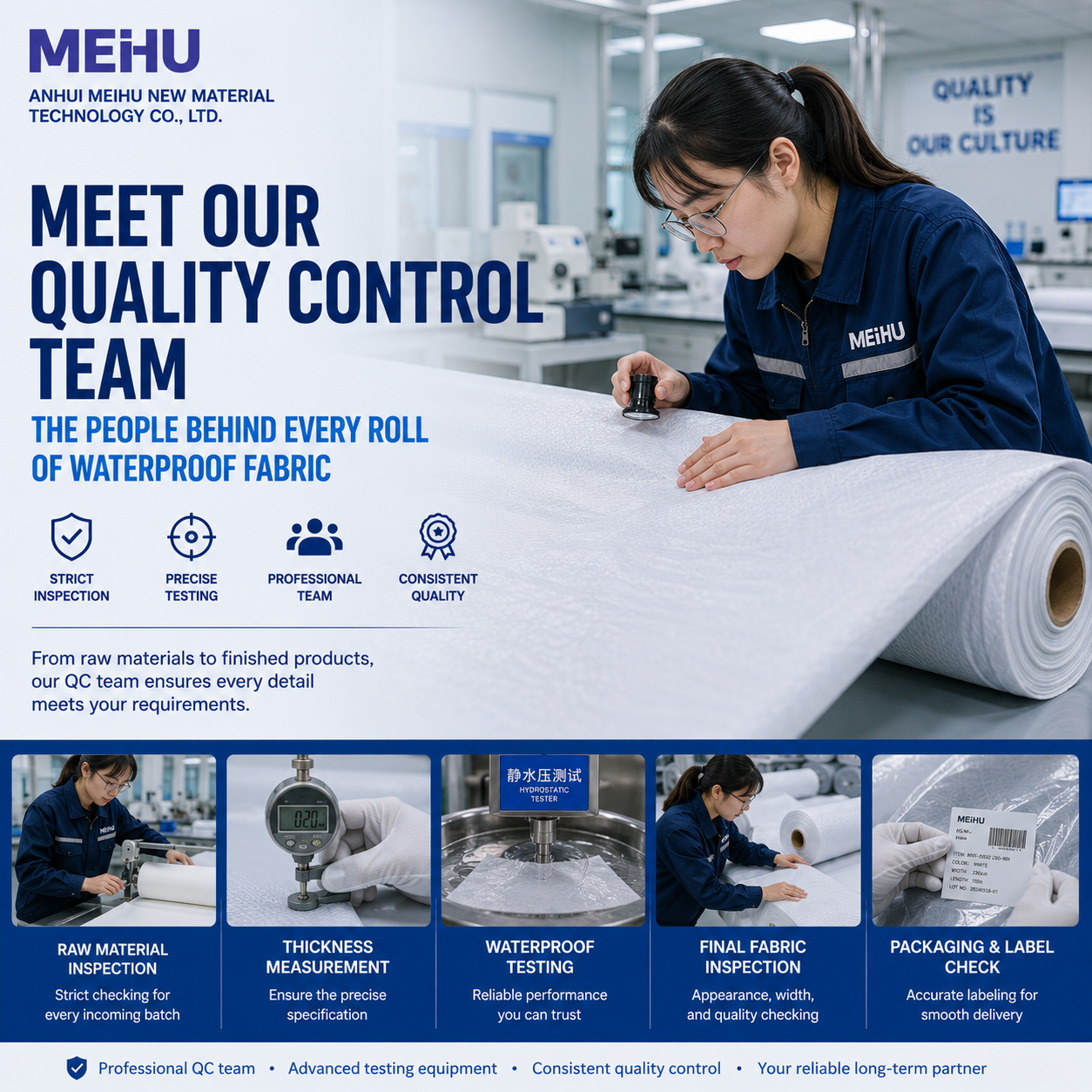
At Meihu, quality control is integrated into the production process rather than treated as a final inspection before shipment.
For every order, our QC and production teams work together to make sure the finished waterproof fabric matches the agreed specifications.
Here’s what that process looks like.
1. Quality Control Starts Before Production
Quality control doesn’t begin when the fabric enters the lamination machine.
It starts with the raw materials.
Before production, materials are checked against the requirements of the order.
Depending on the product, this can include:
Fabric composition
GSM
Width
Color
Surface appearance
TPU film specification
Material condition
This first inspection helps prevent unsuitable materials from entering the production process.
For OEM orders, this is particularly important because the raw material specifications are often customized for a specific customer or application.
2. Checking the Fabric Before Lamination
Before the waterproof layer is applied, the face fabric needs to meet the required condition.
Our team pays attention to factors such as:
Appearance
The fabric should have a consistent and acceptable surface.
Width
The actual fabric width needs to match the agreed specification.
Weight
GSM can affect the final hand feel, thickness, and overall product positioning.
Color
For customized products, maintaining color consistency is especially important.
These checks provide a reliable starting point for the lamination process.
3. Monitoring the TPU Lamination Process
The lamination stage is one of the most important parts of waterproof fabric production.
The TPU membrane needs to bond properly with the textile.
During production, operators and QC personnel monitor the process and look for potential problems such as:
Uneven lamination
Surface defects
Wrinkles
Edge problems
Inconsistent bonding
Abnormal appearance
Production parameters are monitored and adjusted when necessary.
The objective is not simply to produce waterproof fabric.
It is to produce fabric with consistent performance throughout the roll and from batch to batch.
4. Inspecting Finished Fabric During Production
One of the most important principles of quality control is:
Don’t wait until the end to discover a problem.
Finished fabric is inspected during production so that potential problems can be identified as early as possible.
Depending on the product, inspection may focus on:
Surface appearance
Lamination consistency
Width
Roll condition
Color
Overall construction
If an abnormality is identified, the production team can investigate the cause and take corrective action.
This approach helps reduce unnecessary waste and protects the quality of the final shipment.
5. Waterproof Performance Matters
For waterproof laminated fabrics, appearance alone isn’t enough.
The fabric needs to perform its intended function.
Depending on the customer’s requirements, waterproof performance may be evaluated through appropriate water resistance or penetration testing.
For mattress protectors and similar bedding products, reliable waterproof performance is particularly important because the waterproof layer needs to provide protection while maintaining the desired comfort and flexibility of the finished product.
6. QC Is Also About Customer Specifications
Different customers can have completely different requirements for what appears to be the same product.
For example:
Customer A may require:
Soft + Lightweight + Breathable
Customer B may require:
Durable + Wash Resistant + Higher Protection
Customer C may need:
Custom Color + Specific Width + OEM Packaging
That’s why quality control cannot simply follow one universal checklist.
The inspection requirements need to be connected to the approved product specifications and customer requirements.
7. Keeping Production Consistent
For a first sample, producing one acceptable roll may not be enough.
The real challenge is maintaining the same quality during mass production.
This is particularly important for customers who place repeat orders.
A reliable supplier should aim for consistency in:
Fabric construction
GSM
Width
Color
TPU lamination
Appearance
Packaging
The approved sample and confirmed specifications provide an important reference for future production.
8. Final Inspection Before Shipment
Once production is completed, the finished goods go through final checks before shipment.
The team verifies relevant details such as:
Product specifications
Quantity
Roll condition
Packaging
Labels
Shipping marks
This is the final checkpoint before the goods leave the factory.
For international orders, this stage is particularly important because correcting a quality issue after the container has arrived at the customer’s warehouse can be much more difficult and expensive.
9. Communication Is Part of Quality Control
Quality control isn’t only about measuring fabric.
It’s also about communication.
When a problem is found, the QC team needs to communicate with production and sales so that the issue can be understood and addressed.
For OEM customers, communication with the customer is also important.
If a specification needs clarification, it’s better to confirm it before production rather than make assumptions.
This is why we believe:
Good quality starts with clear communication.
What Does a QC Team Look For?
A simple way to understand our approach is to divide quality control into several stages:
Before Production
Materials → Specifications → Sample Reference
During Production
Lamination → Appearance → Width → Construction
After Production
Performance → Quantity → Packaging → Shipment
This creates multiple checkpoints throughout the order process.
Why Quality Control Matters to Overseas Buyers
For an overseas buyer, visiting the factory for every order isn’t practical.
You need to be able to trust that your supplier can consistently manufacture according to the agreed requirements.
A strong quality control process helps reduce risks such as:
Inconsistent product quality
Incorrect specifications
Lamination defects
Color differences
Packaging problems
Shipment discrepancies
More importantly, it gives both sides a clear standard for evaluating the finished product.
Quality Is a Team Effort
At Meihu, quality isn’t the responsibility of one person.
It involves:
Raw Material Team
↓
Production Team
↓
QC Team
↓
Sales & Customer Communication
↓
Final Inspection
Everyone has a role in making sure the finished product meets the customer’s requirements.
The QC team is an important part of this process, but consistent quality ultimately comes from cooperation across the entire production chain.
Looking for a Waterproof Fabric Manufacturer?
Meihu manufactures TPU laminated waterproof fabrics for:
Waterproof mattress protectors
Pillow protectors
Healthcare bedding
Nursing care products
Hospitality applications
Pet products
Other customized waterproof textile products
Whether you’re developing a new product or looking for a long-term manufacturing partner, we can support you from sample development and specification confirmation to production, quality control, packaging, and shipment.
Have a waterproof fabric project? Contact Meihu to discuss your requirements or request samples.
Post time: Aug-25-2026